Optum Behavioral Health Timely Filing: Two Clocks, Both 90 Days
Optum Behavioral Health runs two 90 day clocks. Claims must reach Optum within 90 days of the date of service, but corrections run 90 days from the day Optum received the first claim, not from the remittance. Here is how to count both, how to send a correction, what proves a claim was on time, and where California, Medicaid and VA claims differ.
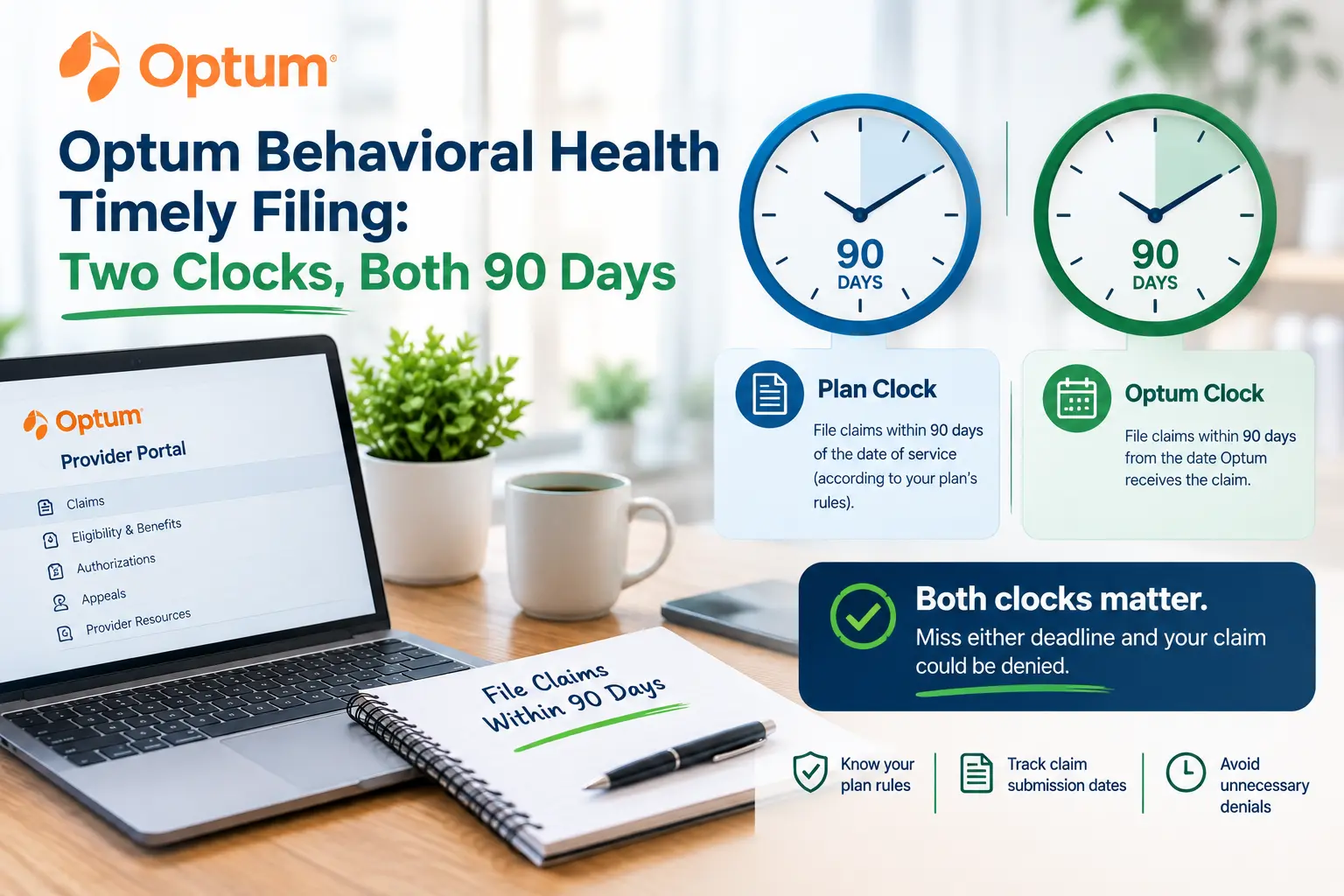
The number is easy to find: 90 days. The catch is that Optum runs two 90 day clocks, and they start on different days.
Optum’s provider site, Provider Express, sets both out in two sentences. First, “all information necessary to process claims must be received by Optum no later than 90 calendar days from the date of service.” Then, “any corrections or additions to a claim should be made within 90 days of receipt of the initial claim.”
So the claim clock starts at the visit. The correction clock starts when Optum receives the first claim. Neither one waits for the remittance.
Optum Behavioral Health at a glance
| Question | What Optum’s documents say |
| New claims | Received by Optum within 90 calendar days of the date of service |
| Corrections and additions | Within 90 days of Optum’s receipt of the first claim |
| How to correct | On Provider Express, choose Corrected or Void and enter the original claim number. On paper, write CORRECTED CLAIM across the top |
| Optum processed it wrong | A Claim Adjustment Request through Claim Inquiry |
| Clinical appeals | 180 days for a clinician or member, unless the law or the plan sets another time frame |
| Provider Services | 877-614-0484 |
Why you still see United Behavioral Health
Optum Behavioral Health manages behavioral health benefits for many UnitedHealthcare plans, and for other health plans and employers. When a member’s behavioral health claims go to Optum, the number on the back of the ID card is the one to call.
Optum’s network manual names the companies behind the brand: “United Behavioral Health and United Behavioral Health of New York, I.P.A., Inc. operating under the brand Optum.”
So United Behavioral Health is the legal name and Optum is the brand. The United Behavioral Health timely filing limit is the same 90 days. California has its own Optum plan and its own rules, covered further down.
Clock one: 90 days from the date of service
The rule counts to the day Optum receives the claim, not the day you send it. A claim your clearinghouse rejects never reached Optum, so its clock kept running.
Optum’s own advice is short: “We recommend that you submit claims shortly after services are provided.” Claims entered on Provider Express or sent electronically need no mailing address, and Optum says they “typically result in faster processing.” Most show a status within about 48 hours.
If Optum is the secondary payer, the network manual says to “bill the primary insurance carrier first, then notify Optum of your findings.” Optum’s claim tips give secondary claims no separate window, so plan on the same 90 days from the date of service unless your plan or state rule gives more. A slow primary payer can use up most of it.
Clock two: corrections run from Optum’s receipt
This is the rule that catches people. Optum wants a correction within 90 days of receiving the first claim, however long the claim took to process.
| Event | Date |
| Date of service | March 2 |
| Optum receives the claim | March 9 |
| Claim pays | April 6 |
| Last day for the claim | May 31 |
| Last day for a correction | June 7 |
Now say the biller spots a wrong modifier on June 10. That is only 65 days after the payment, but 93 days after Optum received the claim. Under Optum’s rule, the correction is late.
Other parts of UnitedHealthcare count differently. Its commercial claim correction page keeps corrections inside the original filing window, and its Wisconsin Medicaid plan gives 180 days from the remittance. The UnitedHealthcare post sets the clocks side by side. For Optum, date every correction from the day Optum received the claim.
How to send an Optum correction
- Online. In Claim Entry on Provider Express, the claim has to be finished first: “claims must be in a finalized status in order to correct or void them.” Choose Corrected or Void as the claim frequency code, and enter the original claim number.
- On paper. Write CORRECTED CLAIM, or VOID CLAIM, across the top of a CMS-1500. Include a copy of the original statement and mail it to the address on that statement.
- When the error is Optum’s. If your claim was right and Optum processed it wrong, do not send a correction. File a Claim Adjustment Request through Claim Inquiry, or call the number on the member’s ID card or the EOB.
Proof when Optum says a claim was late
Because the rule turns on receipt, your proof has to show when Optum received the claim. For an electronic claim, that is the 277CA showing the claim was accepted, not the 999 from your clearinghouse. The timely filing proof post explains the difference, and the CO-29 post covers how to work the denial.
For claims entered on Provider Express, keep a copy of the record in My Submitted Claims.
Optum appeals
For a clinical or benefit denial, Optum’s network manual gives a clinician or a member 180 days to request an appeal. Those time frames apply unless the law or the plan requires something different.
That matches the 180 day minimum the federal claims rule sets for employer plans, which the UMR post explains.
A payment dispute is a separate process, set out in the manual’s section on provider reconsiderations and appeals. Optum’s claim pages give no deadline for a Claim Adjustment Request, so send one as soon as you see the problem.
Medicaid plans set their own windows. At UnitedHealthcare Community Plan of Indiana, where Optum handles behavioral health claims, a reconsideration is due within 60 calendar days of the original EOB. An appeal is due within 60 days of a failed reconsideration.
When 90 days is not the rule
- California. Optum has a separate California plan, U.S. Behavioral Health Plan, California, with its own network manual. State rules bar a plan from setting a claim deadline shorter than 90 days for contracted providers or 180 days for others, counted from the date of service. Secondary claims get at least 90 days from the primary payer’s payment or denial.
- Indiana Medicaid. The claim limit is also 90 days from the date of service, for contracted and other providers alike. Secondary claims get 90 days from the primary payer’s EOB.
- Veterans. Claims for the VA’s Community Care Network in regions 1 to 3 go to Optum. Federal law gives providers 180 days after the care is furnished.
- Optum Care Network. This is a different Optum business, with its own claims manual for states such as Arizona, Nevada and Utah. Its 2024 edition says “Timely filing limit is 90 days or per the provider contract,” with 60 days for reconsiderations and disputes.
Before you bill Optum
- Send claims early. Optum has to receive them within 90 days of the date of service.
- Bill the primary payer first when Optum is secondary, and do it quickly.
- Date every correction from Optum’s receipt of the first claim, not from the remittance.
- Use Claim Inquiry for Optum’s errors, and corrections for yours.
- Keep the 277CA, or the Provider Express record, for every claim.
- Check the state and the program. California, Medicaid and VA claims can run on different rules.
Many Optum corrections come down to a modifier or a code. The behavioral health modifiers post, the credential modifiers post and the H codes post cover those.
Sources
- Optum Provider Express, Very Useful Claim Tips.
- Optum Provider Express, Claim Tips.
- Optum Provider Express, Claim Corrections and Resubmission.
- Optum, Behavioral Health Solutions National Network Manual, August 2025 edition.
- Optum, California network manual, U.S. Behavioral Health Plan, California.
- UnitedHealthcare Community Plan of Indiana, behavioral health, 2025 IHCP Works seminar.
- California Code of Regulations, title 28, section 1300.71, claims settlement practices.
- US Department of Veterans Affairs, community care provider claims.
- 38 U.S.C. 1703D, prompt payment standard.
- Optum Care Network, 2024 claims provider manual.
Reference information only. Not billing advice. Optum’s rules can differ by plan, state and contract. Confirm the limit for the specific plan before you file, correct or appeal a claim.
Related guides
Aetna gives out of network providers 12 months to file medical claims. In network, its provider manual points...
Cigna Healthcare gives participating providers 90 days after the date of service to file a claim, and out of n...
CO-253 isn’t a denial. It’s Medicare’s 2 percent sequestration cut, taken from Medicare’s payment after the de...