Credential Modifiers by License: LCSW, LPC, LMFT, PhD and PsyD
There is no national credential modifier for an LCSW, LPC or LMFT. CMS defines degree levels and two licenses, and Medicare reads the license from enrollment instead. Indiana Medicaid uses HE for four licenses, Ohio gives each license its own U modifier, and Michigan’s Blue plans use HO and AJ. Here is each one, from the payer’s own documents.
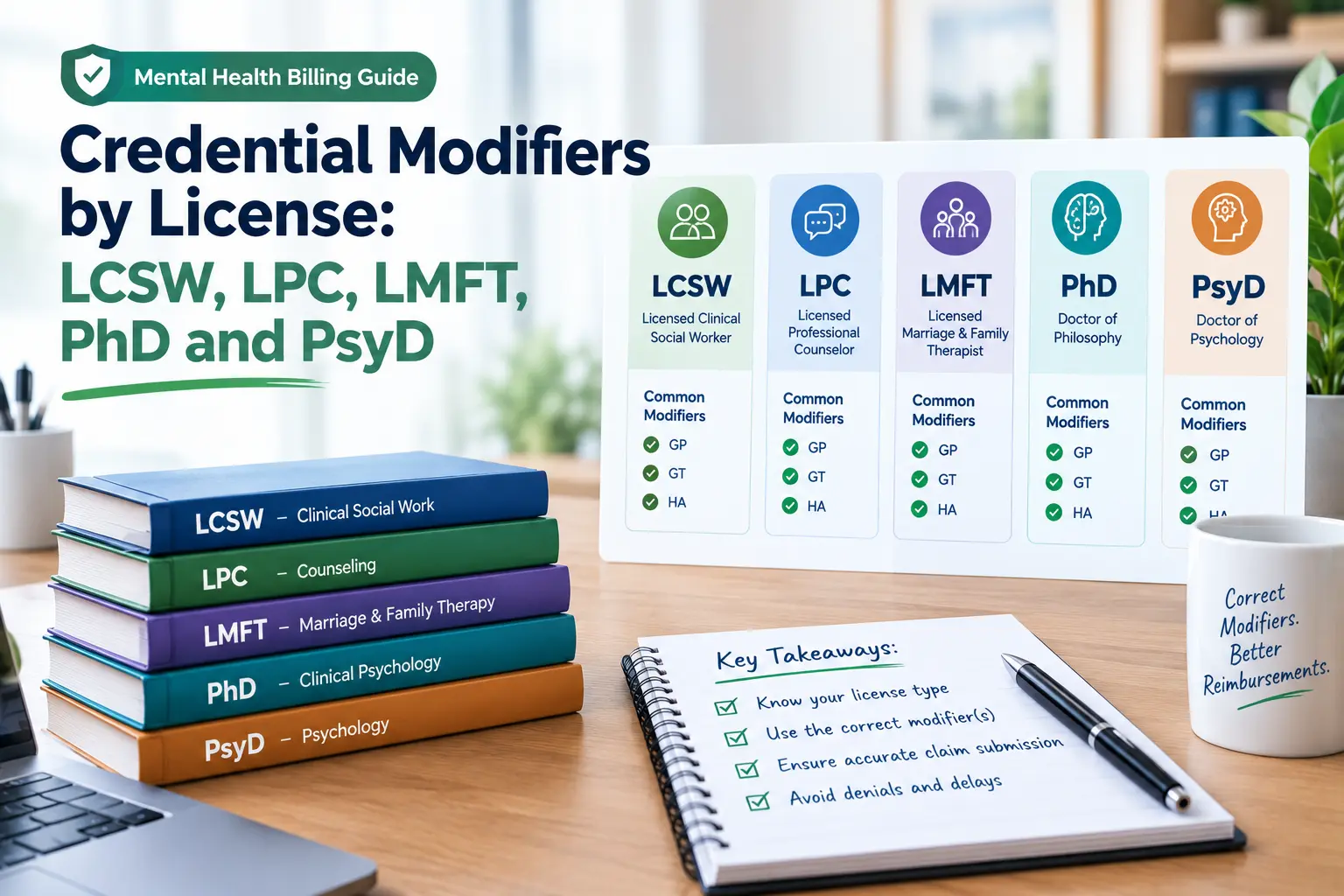
Ask which modifier goes with an LCSW, an LPC or a psychologist and you will get a confident answer. It will be right for one payer.
CMS does not give each license its own modifier. Its national list names credential levels, from HL for an intern to HP for a doctorate. It names just two behavioral health licenses: AH for a clinical psychologist and AJ for a clinical social worker. Everything else is up to whoever pays the claim.
So a social worker’s claim can need HE from Indiana Medicaid, U4 or UF from Ohio Medicaid, AJ from Michigan’s Blue plans, and no modifier at all from Medicare. Here is how each of those works, from each payer’s own documents.
The short answer by license
| License | CMS level | Medicare | Indiana Medicaid | Ohio Medicaid |
| LCSW | HO | None required. Enrolls as a clinical social worker | HE | UF for an LISW. U4 for an LSW |
| LPC or LMHC | HO | None required. Enrolls as a mental health counselor | HE for an LMHC | U2. UH for an LPCC |
| LMFT | HO | None required. Enrolls as a marriage and family therapist | HE | U5. UG for an LIMFT |
| Psychologist, PhD or PsyD | HP | None required. Enrolls as a clinical psychologist | AH | AH, in its section for other licensed professionals |
Indiana’s modifiers apply when a service is billed under a supervising practitioner’s NPI. Ohio’s come from its list for fee for service claims, which marks UF, UG and UH as additional licenses. License names change at state lines too. Ohio’s independent social work license is the LISW, and Indiana calls its counselors LMHCs.
What CMS defines: credential levels and two licenses
These are the official descriptions in the CMS HCPCS file:
| Modifier | Official CMS description |
| HL | Intern |
| HM | Less than bachelor degree level |
| HN | Bachelors degree level |
| HO | Masters degree level |
| HP | Doctoral level |
| AH | Clinical psychologist |
| AJ | Clinical social worker |
| U1 to UD | Medicaid level of care 1 to 13, “as defined by each state” |
Read the H rows closely. HO is a degree level, not a license, so an LCSW, an LPC and an LMFT all fall under it. HP covers a PhD and a PsyD alike.
That is why a search for the PhD or PsyD credential modifier has two answers. It is HP if the payer goes by degree, and AH if it goes by license. Counselors and marriage and family therapists have no license modifier in the CMS file at all, and a U modifier means nothing until a state defines it.
Medicare: the enrollment carries the license
Original Medicare does not need a credential modifier. In 2013 CMS told its contractors to stop requiring AH and AJ, which it said were “no longer necessary for identification purposes.” The modifiers still exist. Medicare just does not require them.
Medicare reads the license from the rendering clinician’s enrollment instead. Each type has its own specialty code:
| License | Medicare enrolls it as | Specialty | Paid at |
| Psychologist, PhD or PsyD | Clinical psychologist | 68 | The fee schedule amount |
| LCSW | Clinical social worker | 80 | 75 percent of the fee schedule amount |
| LPC, LMHC or LPCC | Mental health counselor | E2 | 75 percent of the fee schedule amount |
| LMFT | Marriage and family therapist | E1 | 75 percent of the fee schedule amount |
Counselors and marriage and family therapists have billed Medicare on their own since January 1, 2024. CMS counts a licensed mental health counselor, clinical professional counselor or professional counselor as a mental health counselor. Addiction counselors who meet the same requirements can enroll that way too.
So for Original Medicare, getting the license right means getting the enrollment right. A modifier cannot change what the enrollment says. Medicare Advantage plans are another matter, because they can set their own billing rules, as the Michigan example below shows.
Indiana Medicaid: one modifier for four licenses
Indiana’s April 2026 bulletin lists the modifiers for behavioral health services billed under a supervising practitioner’s NPI, with the reimbursement percentage for each:
| License | Modifier | Reimbursement |
| Licensed psychologist | AH | 100 percent |
| LCSW, LMFT, LMHC or LCAC | HE | 75 percent |
| Behavioral health intern | HL | 50 percent |
HE is the surprise. In the CMS file it means “Mental health program,” a program modifier. In Indiana it marks four licenses at once: clinical social workers, marriage and family therapists, mental health counselors and clinical addiction counselors.
Not every service needs one. The bulletin says Medicaid Rehabilitation Option services “do not require additional modifiers that identify the provider that renders the service.”
Indiana is also reprocessing older claims. A bulletin dated October 8, 2026 says practitioner claims for behavioral health with dates of service on or after October 1, 2024 will be mass adjusted or reprocessed. The changes show on remittance advices from October 14, 2026.
Ohio Medicaid: a U modifier for each license
Ohio’s 2026 list of the modifiers its fee for service program recognizes, revised July 8, 2026, has a behavioral health section that reads like a license directory:
| Modifier | In Ohio behavioral health |
| U1 | Psychology assistant, psychology assistant intern, psychology assistant trainee |
| U2 | Licensed professional counselor |
| U3 | Licensed chemical dependency counselor II or III |
| U4 | Licensed social worker (LSW) |
| U5 | Licensed marriage and family therapist (LMFT) |
| U6 | Chemical dependency counselor assistant |
| U7 | Counselor trainee |
| U8 | Social worker assistant |
| U9 | Social worker trainee |
| UA | Marriage and family therapist trainee |
Independent licenses get modifiers of their own, each listed as an “Additional license”: UF for an LISW, UG for an LIMFT, UH for an LPCC and UB for an LICDC. The same section uses HM, HN and HO for degree levels. For which services each one can bill, the list points to Ohio’s behavioral health provider manual and code charts.
Some of these letters already have a national meaning. CMS defines UF as “Services provided in the morning,” and Ohio uses it for an LISW. CMS defines UK as services provided on behalf of the client to someone other than the client. In Ohio’s behavioral health list, UK is a qualified mental health specialist with three years of experience.
U2, U6 and U9: one modifier, several meanings
Ohio’s list says the state decides how each U modifier is used, and that the same one can mean different things with different codes. Its own entries show how far that goes:
| Modifier | Ohio behavioral health | Elsewhere in the same list |
| U2 | Licensed professional counselor | Telehealth: the patient was at school |
| U6 | Chemical dependency counselor assistant | Telehealth: the patient was in an intermediate care facility for individuals with intellectual disabilities. Home care waiver: a therapeutic or kosher home delivered meal, billed with S5170 |
| U9 | Social worker trainee | An RN consultation billed with T1001, or an RN assessment billed with G0493 |
And that is one state’s fee for service list. Ohio’s managed care plans, the list adds, “may have different claim submission requirements.”
So a U modifier means nothing on its own. You need the state, the payer, the program and the code it sits on.
Commercial and Medicare Advantage plans: the Michigan example
Commercial plans set their own rules, and some do want credential modifiers. Blue Cross Blue Shield of Michigan and Blue Care Network are one example. Their FAQ for LLPs, LMFTs and other limited licensed clinicians, revised September 2026, covers Blue Cross commercial, BCN commercial and BCN Advantage. Its modifier rules include:
- HO for limited licensed professional counselors, limited licensed marriage and family therapists and temporary limited licensed psychologists.
- AJ for limited licensed master’s social workers.
- SA as well when billing under supervision, for dates of service from September 1, 2026 through February 28, 2027. In the FAQ’s words, limited licensed clinicians “must use modifier SA on the claim in addition to any applicable modifier (HO or AJ).” CMS defines SA for a nurse practitioner working in collaboration with a physician.
- The supervisor’s NPI. When billing under a fully licensed psychologist or a physician, “the supervising provider’s NPI must be used and the appropriate modifier is required.”
BCN Advantage is a Medicare Advantage plan. So a Medicare member’s claim can need a credential modifier that Original Medicare never asks for.
Other plans may want none. Your contract and the plan’s behavioral health billing guide decide. If neither asks for a credential modifier, leave it off.
Before you set a credential modifier in your billing system
- Set it per payer, not per clinician. One LCSW can need HE from Indiana Medicaid and no modifier from Medicare.
- Note when it applies. Indiana’s modifiers apply only when you bill under a supervisor’s NPI.
- Map the license, not the degree. In Ohio, an LSW and an LISW are both social workers, and they carry different modifiers.
- Update it when a license changes. When a trainee is licensed, or a limited license becomes a full one, the modifier can change with it.
- For Medicare, check the enrollment. The specialty on the clinician’s enrollment carries the license.
- Watch remittances after a policy change. Indiana’s mass adjustment reaches back to claims from October 2024.
How credential modifiers stack with program and setting modifiers on one claim line is in the behavioral health modifiers post. The codes they attach to are in the behavioral health H codes post. Which NPI goes in the rendering provider field, and why enrollment matters as much as the number, is in NPI Type 1 vs Type 2.
Sources
- CMS Transmittal 2656, claims processing for nonphysician practitioners, February 2013.
- CMS Transmittal 12235, specialty codes E1 and E2 for marriage and family therapists and mental health counselors, September 2023.
- CMS, marriage and family therapists and mental health counselors.
- First Coast Service Options, Medicare provider and supplier specialty codes.
- Indiana Health Coverage Programs, Bulletin BT202655, April 2026.
- Indiana Health Coverage Programs, Bulletin BT2026167, October 2026.
- Ohio Department of Medicaid, modifiers recognized, 2026, revised July 2026.
- Blue Cross Blue Shield of Michigan and Blue Care Network, FAQ for LLPs and LMFTs, September 2026.
- CMS HCPCS Level II, the official modifier descriptions, in our modifier lookup.
Reference information only. Not billing advice. Credential modifier rules are set by each payer and change often. Confirm them in the payer’s current manual or your contract before you bill.
Related guides
Seven detox codes form a neat grid by setting and intensity, and four residential codes split on length of sta...
H0031 has a national definition five words long. Washington bills it in 15 minute units, South Carolina once p...
In most of medical billing the procedure code decides what you get paid and the modifier adjusts it. In Medica...