Behavioral Health Modifiers: The Rate Is in the Letters
In most of medical billing the procedure code decides what you get paid and the modifier adjusts it. In Medicaid behavioral health that is almost reversed. The same code billed with HO instead of HN pays at a different tier, which means a wrong credential modifier is not a coding error. It is a claim for a different amount of money than the one you earned. Here is how the three families work.
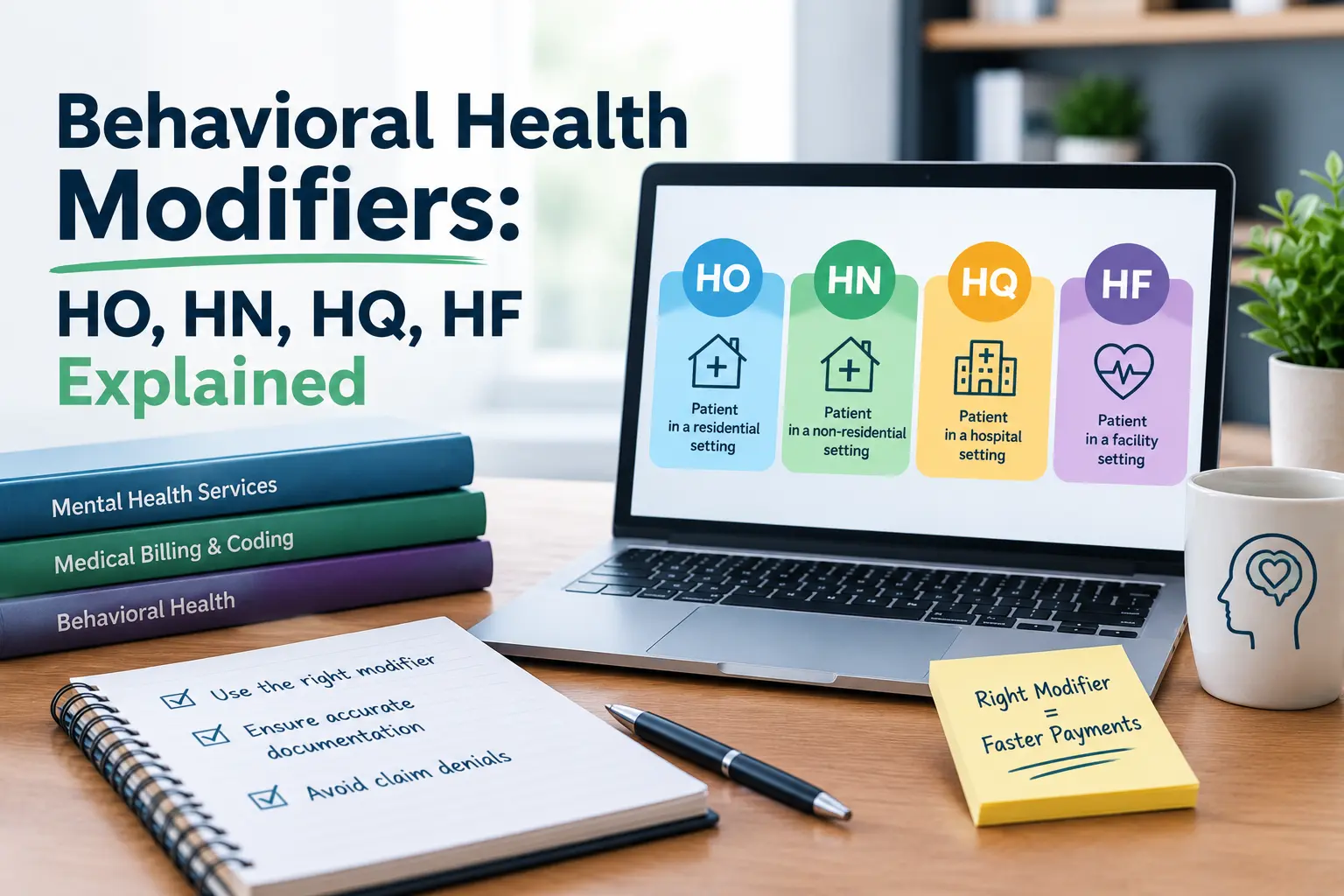
In most of medical billing, the procedure code decides what you get paid and the modifier adjusts it. In Medicaid behavioral health that is almost reversed. The same code billed with different modifiers can pay at three different rates, and the modifier is doing most of the work.
That changes what a wrong modifier means. It is not a formatting error that produces a denial. It is a claim for a different amount of money than the one you earned.
Every H modifier and what CMS says it means
These are the official descriptions CMS publishes for all 26 H modifiers. Each code links to its page in our modifier lookup, and the rest of this post explains how they work together on a claim.
| Modifier | Official CMS description | Family |
| HA | Child/adolescent program | Program |
| HB | Adult program, non geriatric | Program |
| HC | Adult program, geriatric | Program |
| HD | Pregnant/parenting women's program | Program |
| HE | Mental health program | Program |
| HF | Substance abuse program | Program |
| HG | Opioid addiction treatment program | Program |
| HH | Integrated mental health/substance abuse program | Program |
| HI | Integrated mental health and intellectual disability/developmental disabilities program | Program |
| HJ | Employee assistance program | Program |
| HK | Specialized mental health programs for high-risk populations | Program |
| HL | Intern | Credential level |
| HM | Less than bachelor degree level | Credential level |
| HN | Bachelors degree level | Credential level |
| HO | Masters degree level | Credential level |
| HP | Doctoral level | Credential level |
| HQ | Group setting | Setting |
| HR | Family/couple with client present | Setting |
| HS | Family/couple without client present | Setting |
| HT | Multi-disciplinary team | Team |
| HU | Funded by child welfare agency | Funding source |
| HV | Funded state addictions agency | Funding source |
| HW | Funded by state mental health agency | Funding source |
| HX | Funded by county/local agency | Funding source |
| HY | Funded by juvenile justice agency | Funding source |
| HZ | Funded by criminal justice agency | Funding source |
Two groups do not come up again below. HT marks a multidisciplinary team. HU to HZ say who funds the service, from a child welfare agency to a criminal justice agency, rather than anything about the service itself.
Three questions, three families
Nearly every behavioral health claim answers three things through its modifiers.
- Who delivered it. The credential level of the rendering clinician.
- Under what program. Mental health, substance use, child, adult, geriatric.
- In what setting. Individual, group, family with or without the client present.
Knowing which question you are answering narrows the choice to two or three candidates every time.
Credential modifiers are a rate tier
This is the family that matters most, and the one people treat least carefully.
| Modifier | Level | Typical credentials | Relative rate |
| HP | Doctoral | PhD, PsyD | Highest |
| HO | Master’s degree | LCSW, LPC, LMFT, LMSW | Standard |
| HN | Bachelor’s degree | Case managers, BSW | Lower |
| HM | Less than bachelor’s | Technicians, paraprofessionals | Lowest |
The payer uses this letter to select a fee schedule. Billing HO for a service a bachelor’s level clinician delivered is not a coding mistake. It is billing for a rate you did not earn, and that is a payment integrity question rather than a coding one.
The reverse costs you money quietly. Billing HN when a master’s level clinician delivered the service pays at the lower tier and nobody notices, because the claim pays and nothing denies. An organization with a mixed credential roster and a default modifier in its billing template can underbill for years.
There is a third failure worth knowing. If a clinician is enrolled with the payer at one credential level and claims arrive carrying a different one, the claim can deny outright. The modifier has to match the enrollment, not just the diploma.
The right modifier for an LCSW, LPC, LMFT, PhD or PsyD depends on the payer. Credential modifiers by license maps it for Medicare, two state Medicaid programs and a commercial plan.
Program modifiers select the fee schedule
These say what kind of program the service was delivered under, which often points the payer at an entirely different rate table.
| Modifier | Program | Notes |
| HE | Mental health program | Common on community mental health and state funded services |
| HF | Substance abuse program | Often a different fee schedule from HE for the same procedure code |
| HH | Integrated mental health and substance abuse | Not a substitute for billing HE and HF separately. A distinct program type |
| HA | Child and adolescent program | Population based, not age based. The program has to be one |
| HB | Adult program, non geriatric | Paired with HC to split the adult population |
| HC | Adult geriatric program | Distinct program, not simply an older patient |
| HK | Specialized program for high risk populations | Definition of high risk is set by the state, not by you |
The distinction people get wrong here is between a program and a patient. HA does not mean the patient was fifteen. It means the service was delivered under a program designated for children and adolescents. If your organization does not operate one, the modifier does not apply however young the patient is.
Setting modifiers
- HQ Group setting.
- HR Family or couple therapy with the client present.
- HS Family or couple therapy without the client present.
HR and HS exist because collateral work with a family when the client is not in the room is a different service with different rules, and some payers cover one and not the other.
They stack, and the order can matter
A single claim line routinely carries two or three of these, and they are not interchangeable in position.
Group therapy, master’s level clinician, substance use program: <procedure code> HF HQ HO
Case management, bachelor’s level, mental health program: <procedure code> HE HN
Payers differ on required order, and getting it wrong can produce payment at the wrong rate even when every modifier on the claim is correct. The claim does not deny. It just pays the wrong amount, which is the hardest kind of error to notice.
There is no universal rule for the order. It comes from the payer’s billing manual, and it is worth writing down for each of your top payers rather than rediscovering it after a rate variance.
Medicare does not want any of this
Credential modifiers are a Medicaid construct. Medicare does not require HN, HO or HP on behavioral health claims, and appending them where they are not expected is a different kind of problem from omitting them where they are.
So an organization billing both runs two different claim builds for the same service. That is the same structural issue telehealth place of service creates, and it has the same answer: a small internal table of what each payer wants, checked quarterly.
The U modifiers are a trap
U1 through UD are reserved for state Medicaid programs to define however they wish. They mean completely different things in different states.
In one state U1 might indicate a level of care. In another it might identify a funding source or a waiver program. There is no national definition to look up, because there is no national definition.
If you bill across state lines, these cannot be carried in a shared billing template. They have to be configured per state, from that state’s own Medicaid manual, and nothing else is authoritative.
Where to actually find your rules
Behavioral health has more state variation than any other area of billing, so the usual advice to check the payer manual carries more weight here than usual.
- Start with your state Medicaid behavioral health provider manual, not a national reference
- For managed care, check the plan’s own manual, which can differ from the state fee for service rules
- Confirm which credential modifiers are required, which are optional, and which are rejected
- Confirm the required order when more than one applies
- Record the section number and the date you checked, because you will need both when a rate is questioned
Ohio shows how detailed a state can get. Its 2026 Medicaid modifier list gives behavioral health license levels their own U modifiers, such as U2 for a licensed professional counselor and U5 for a licensed marriage and family therapist. Your own state’s list is the one that counts.
What to do next
- Pull a sample of behavioral health claims and check the credential modifier against who actually rendered the service
- Check whether your billing template has a default credential modifier. If it does, find out who set it and why
- Compare what you are paid for the same code at different credential tiers. If there is no difference, you may be billing the wrong one consistently
- Confirm each clinician’s enrolled credential level matches the modifier their claims carry
- If you operate in more than one state, verify your U modifiers are configured per state rather than globally
Every modifier named here has its own page with the official CMS descriptor and release date in the HCPCS modifier lookup. The credential family is HM, HN, HO and HP. The program family runs from HA through HK, and the setting modifiers are HQ, HR and HS.
Modifier misuse is also one of the routes to a bundling denial. CO-97 explained covers how to tell an appealable bundle from an absolute one before you write the appeal.
Sources
- CMS HCPCS Level II. The official descriptors, published quarterly in the public domain.
- Medicaid.gov. Entry point for state programs, each of which sets its own behavioral health rules.
- Ohio Department of Medicaid, modifiers recognized, 2026. One state’s own definitions for the U modifiers, revised July 2026.
- Your own state Medicaid behavioral health provider manual, which is the only authority for your claims and overrides every national reference including this one.
Reference information only. Not billing advice. Behavioral health modifier requirements vary substantially by state and by plan. Verify against your own state Medicaid manual before you file.
Related guides
There is no national credential modifier for an LCSW, LPC or LMFT. CMS defines degree levels and two licenses,...
Seven detox codes form a neat grid by setting and intensity, and four residential codes split on length of sta...
H0031 has a national definition five words long. Washington bills it in 15 minute units, South Carolina once p...