Behavioral Health H Codes: The Code Is National, the Rules Are Not
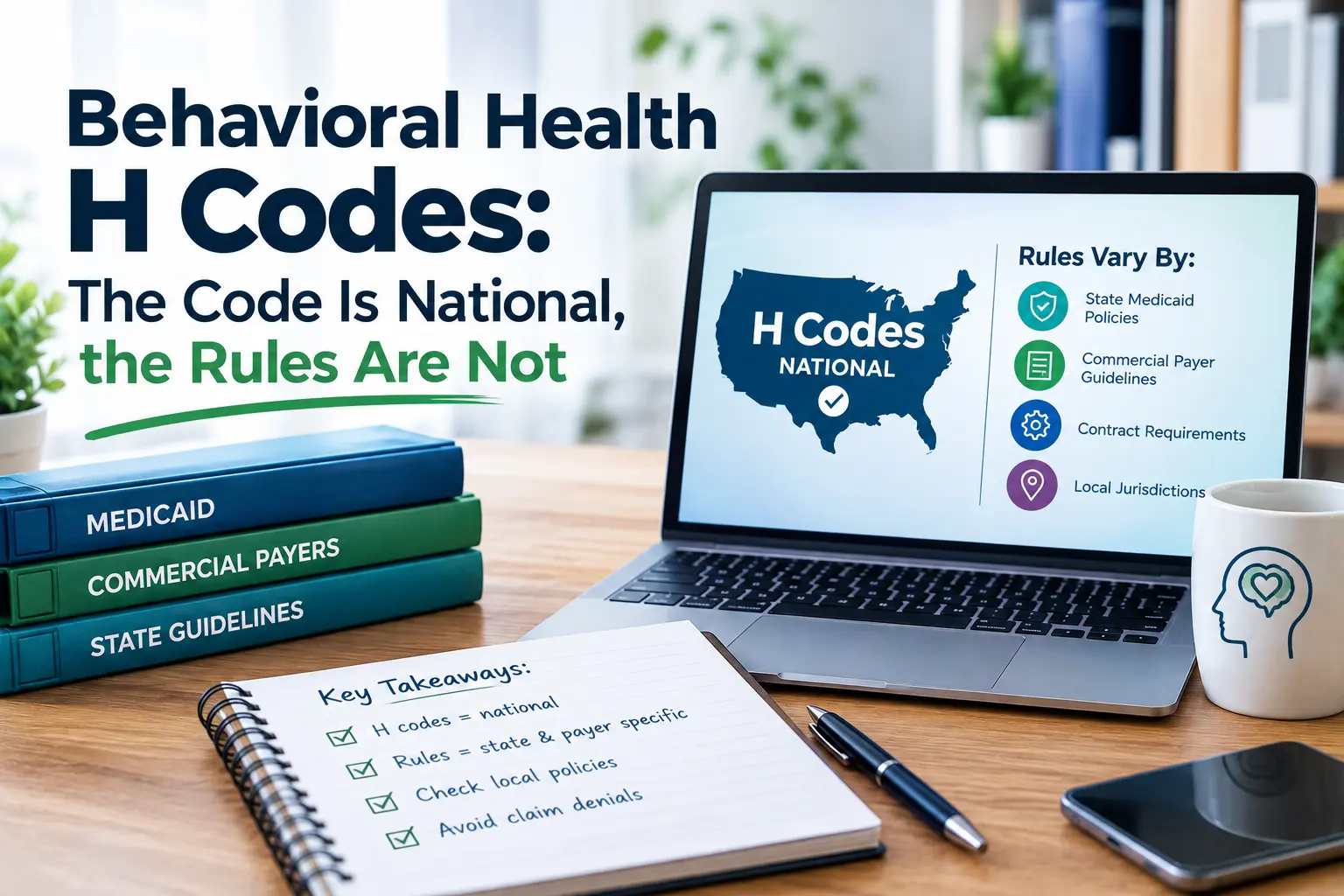
H0031 has a national definition five words long. Washington bills it in 15 minute units, South Carolina once per encounter, and Oregon put it on its substance use disorder fee schedule. All 94 H codes are marked not payable by Medicare, and nearly half never say what a unit is. Here is what CMS defines, what it leaves to your state, and where that catches billers.
The last post here was about behavioral health modifiers, the letters at the end of the claim line. This one is about the code they sit on.
Here is the complete national definition of H0031, as CMS publishes it: “Mental health assessment, by non-physician.” That is the whole thing. It does not say how long the assessment runs, how often it can be billed, who may perform it, or what counts as one unit.
The states decide all of that, and they do not decide it the same way.
| State | How H0031 is billed | Edition quoted |
| Washington | In 15 minute units | Service Encounter Reporting Instructions, 2025 |
| South Carolina | One unit per encounter, up to 12 a year, used for follow up after a comprehensive diagnostic assessment | Rehabilitative behavioral health procedure codes, January 2025 |
| Oregon | One payment per service, on the substance use disorder tab of the fee schedule | Oregon Health Authority notice, May 2025 |
Same code, three different services. A code whose national descriptor says mental health assessment turns up on Oregon’s substance use disorder fee schedule. That is the whole H range in one example, and it is why the national descriptor is where your research starts, never where it ends.
What the H range covers
The July 2026 HCPCS file from CMS lists 94 active H codes, running from H0001 to H2041. Most are mental health and substance use services. A few are other state program services that share the range: extra prenatal services when a pregnancy is at risk (H1000 through H1005), family planning education (H1010), child foster care (H0041 and H0042) and supported housing (H0043 and H0044).
CPT covers office psychotherapy and psychiatric evaluation. It has very little for the community services that Medicaid programs pay for: peer support, psychosocial rehabilitation, assertive community treatment, supported employment, clubhouse programs and residential treatment billed by the day. Those live in the H range.
The range is still growing. Six of its codes carry effective dates from 2022 or later in the file, including traditional healing services and coordinated specialty care after a first episode of psychosis.
Medicare pays none of them
Every record in the CMS file carries a Medicare coverage code. All 94 H codes carry the same one, the letter I, which the file’s own record layout defines as “Not payable by Medicare.”
There is nothing to appeal there. It means the claim was built for the wrong payer. If your organization bills Medicare as well as Medicaid, your H code rows belong on Medicaid claims and never on Medicare ones, and a template that adds them to every behavioral health claim will produce Medicare claims that cannot be paid.
The same goes for the codes billers meet next to them. Targeted case management, T1017, and crisis intervention billed by the hour, S9484, carry the same coverage code. Medicaid programs and their managed care plans are the main payers for all of these. Some commercial plans accept certain ones, and that plan’s manual is the only place to find out which.
Nearly half never define a unit
Of the 94 H code descriptors, 45 name no unit at all. Another 21 are per 15 minutes and 20 are per diem. The rest are per hour, per month, per half day, per session or per encounter.
When the descriptor is silent, the state supplies the unit. That is how H0031 became three different services. It is also why H code knowledge does not travel well. A biller who learned the range in one state and moves to another is carrying definitions that may not apply there.
The difference can open up inside a single state. South Carolina bills H0032, service plan development, two ways. Under its rehabilitative behavioral health program it is billed in 15 minute units, up to 10 a week. Under its substance use services program it is one unit per session, up to six in a rolling 12 months.
Same code, same state, two units. Which one applies depends on which program the client is in.
A stated unit still does not say how many to bill
“Per 15 minutes” tells you how long a unit is. It does not tell you how many minutes earn one.
Plenty of billers apply an 8 minute threshold to every 15 minute code out of habit. It comes from Medicare’s rule for timed therapy services. State Medicaid programs set their own, and they do not all use it.
Washington’s 2025 encounter reporting instructions show how different that can be. The first unit can be reported once the service comes within 5 minutes of a full unit, so a 15 minute code needs at least 10 minutes. Each unit after that follows a halfway rule, so 8 more minutes earns another. A 23 minute service is two units. A 9 minute service is none.
Then come the exceptions. The same instructions let the first unit of crisis intervention, H2011, be reported for anything from 1 to 22 minutes. South Carolina bills H2011 in plain 15 minute units, capped at 16 a day and 80 a year.
If your billing system turns minutes into units with one rule for every state, it is right in some places and wrong in others. A default built on 8 minutes reports a unit for a 9 minute session that Washington’s rules say was never earned.
Twins: one service, two units
At least 15 services appear in the H range twice, each under a different unit. Most pairs are a 15 minute code and a per diem code.
| Service | Per 15 minutes | Per diem |
| Psychosocial rehabilitation | H2017 | H2018 |
| Therapeutic behavioral services | H2019 | H2020 |
| Comprehensive community support | H2015 | H2016 |
| Community psychiatric supportive treatment | H0036 | H0037 |
| Assertive community treatment | H0039 | H0040 |
| Skills training and development | H2014 | H2038 |
| Supported employment | H2023 | H2024 |
Your state decides which one it pays, and they are not interchangeable. Washington’s instructions put it plainly: a service delivered for less than a day must be billed with a code that is not per diem.
A per diem pays for the day. Adding timed units of the same service for the same client on the same day asks to be paid twice for the same hours.
The pairing even crosses ranges. H0019 is residential treatment for stays typically longer than 30 days, without room and board, billed per diem. T2048 describes the same kind of stay with room and board. Which one is right depends on whether room and board is part of what the program provides.
Where the modifiers attach
The modifiers from the last post attach to these codes, and the state decides that layer as well.
South Carolina’s table for psychosocial rehabilitation, H2017, uses U1 through U5 for individual service by staff level and U6 through UA for group. Under its substance use services program, the same code takes HQ for group instead. Washington’s 2025 instructions list their own set on H0031, including U8, UC and UD.
That is the U modifier problem from the last post, seen in a real table. The national descriptor for U1 reads “Medicaid level of care 1, as defined by each state.” South Carolina uses it to mark a staff level instead. U1 means exactly what South Carolina’s table says it means, and only in South Carolina.
What to do with this
- Read the state manual before the national descriptor. The CMS file names the service. The manual defines it.
- Build your H code rows per state and per program. An organization billing in more than one state cannot share them, and South Carolina shows that one state may need two versions of the same code.
- Check the unit rules before you configure your system. Before you set how it turns minutes into units, confirm the state’s threshold for the first unit, its rounding rule for extra units, and its daily and annual caps.
- Know which twin your state pays. Check the manual before billing a timed code and its per diem twin for the same client on the same day.
- Keep H codes off Medicare claims.
- Write down the manual section and the date you checked it. Every state example in this post is tied to a dated edition for exactly that reason.
Every code named here has its own page in the HCPCS lookup, with the official CMS descriptor and the date of the file it came from.
Sources
- CMS HCPCS quarterly update. The July 2026 file, including the Medicare coverage code on every record.
- Washington State Health Care Authority, Service Encounter Reporting Instructions. Version 2025 is quoted here. The page lists the current edition.
- South Carolina Department of Health and Human Services, rehabilitative behavioral health procedure codes, section updated January 2025.
- Oregon Health Authority, notice adding H0031 to the behavioral health fee schedule, May 2025.
- Your own state Medicaid behavioral health manual, which is the only authority for your claims and overrides every national reference, including this one.
Reference information only. Not billing advice. H code definitions, units and limits vary by state, by program and by plan. Verify against your own state Medicaid manual before you file.
Related guides
There is no national credential modifier for an LCSW, LPC or LMFT. CMS defines degree levels and two licenses,...
Seven detox codes form a neat grid by setting and intensity, and four residential codes split on length of sta...
In most of medical billing the procedure code decides what you get paid and the modifier adjusts it. In Medica...