NPI Type 1 vs Type 2: Which Number Goes Where on a Claim
Type 1 belongs to a person, Type 2 belongs to a business. Easy enough until you hit the sole proprietor question, where being incorporated changes which number goes in Box 33a. Box 24J is always the individual, and Medicare will reject a group NPI there. Here is where each number belongs, on paper and in the 837P, and the rejections you get when it is wrong.
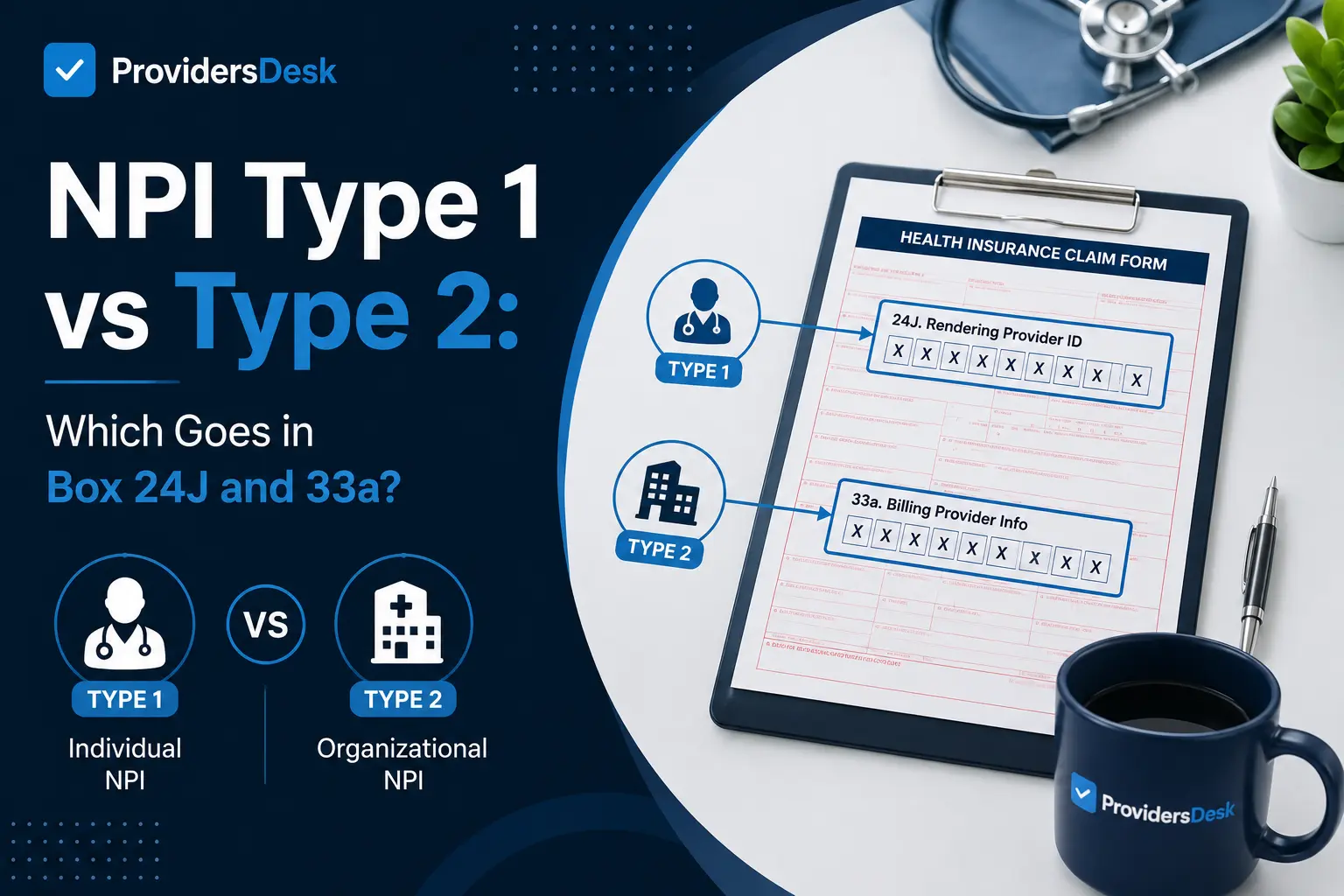
Type 1 belongs to a person. Type 2 belongs to a business. On a claim, Box 24J is always the individual who did the work, and Box 33a is whoever is getting paid.
The definitions are easy. Where practices lose money is in the sole proprietorship question and the difference between being incorporated and not.
What each type actually is
Type 1 is assigned to an individual. A physician, a nurse practitioner, a physical therapist, a licensed clinical social worker. One per person, permanently. It follows you between employers, across state lines, and through name changes. It is never reissued to anyone else.
Type 2 is assigned to an organization. A group practice, a hospital, a professional corporation, an LLC. It belongs to the legal entity, not to any person inside it.
A large organization can hold several Type 2 numbers, one for each subpart that bills separately. A hospital with a distinct rehabilitation unit and its own outpatient lab may enumerate each one.
You can look up any provider or organization in the NPI lookup tool, which shows the entity type, taxonomy, and whether the record is still active.
The sole proprietor question, which is where it goes wrong
This is the section worth reading twice, because two situations that feel identical are billed differently.
If you are a sole proprietor and not incorporated
You are an individual, legally. You get a Type 1, and that is all you get. There is no separate business to enumerate, so there is no Type 2 to apply for.
On a claim, your Type 1 number goes in both Box 24J and Box 33a. You rendered the service, and you are also the entity being paid.
If you have incorporated, even as a solo practice
Now there are two legal persons: you and the corporation. Each needs its own number.
The corporation gets a Type 2. On a claim, your Type 1 goes in Box 24J because you saw the patient, and the corporation’s Type 2 goes in Box 33a because the corporation holds the contract and receives the payment.
Solo providers who incorporate and keep billing the way they always did are the most common version of this error. The claims worked yesterday, the corporate paperwork changed nothing about the day-to-day, and nobody thought to update the billing setup.
Where each number goes
| Box | What it is | Which NPI | Type |
| 24J | Rendering provider | The clinician who saw the patient | Always Type 1 |
| 33a | Billing provider | Whoever is paid | Type 2, or Type 1 if unincorporated solo |
| 32a | Service facility | Where the service happened, if not the billing address | Type 2 |
| 17b | Referring provider | Who sent the patient | Type 1 |
Box 24J is the one to be strict about. Medicare will not accept a Type 2 number in the rendering provider field, and most commercial payers will not either. A group NPI in that box is a rejection, and the message you get back rarely says so plainly.
The same fields on an electronic claim
Almost nobody files paper anymore, but the paper boxes are still how everyone talks about this. Here is the mapping to the 837P, which is what actually goes out.
| CMS-1500 | 837P loop | Role |
| Box 33a | 2010AA | Billing provider |
| Box 24J | 2310B | Rendering provider |
| Box 32a | 2310C | Service facility |
If your software is set up correctly, you never touch these directly. If claims are rejecting on provider identifiers and the boxes look right on screen, it is worth asking your vendor which loop each field actually populates.
Rejections this causes, and how they read
- A group NPI in the rendering field. Rejects at the payer or clearinghouse, often with a generic identifier message rather than anything pointing at Box 24J.
- An individual NPI in the billing field when the group holds the contract. Payment goes to the wrong party, or the claim is rejected because the NPI does not match the tax ID on file.
- A rendering provider not enrolled with that payer. The NPI is valid, and the enrollment is not. These are different things, and having a number does not mean you are set up to be paid.
- A newly incorporated solo practice still billing under Type 1 in both boxes. Works until the payer notices the tax ID no longer matches, then stops.
An NPI is not a credential.
CMS states this directly, and it is worth repeating because the assumption costs people money.
An NPI is issued on application. It confirms that someone applied for a number, and nothing else. It is not evidence of licensure, of enrollment with any payer, of privileges anywhere, or of good standing.
Verify licensure with the relevant state board. Verify exclusion status with the OIG. Verify enrollment with the payer directly. The NPI registry answers none of those questions.
Things that do not change your NPI
- Changing employer
- Moving to another state
- Changing your name
- Adding or changing a specialty
- Letting a license lapse and reinstating it
All of those require you to update the record, and none of them produce a new number. Applying for a second Type 1 because your details changed creates a duplicate, and duplicates cause claim problems that take months to unwind.
Update an existing record at nppes.cms.hhs.gov. Corrections there reach downstream systems on the next data refresh, which is monthly.
What to do next
- Confirm which legal entity holds each payer contract. That determines what belongs in Box 33a
- If you are a solo practice, check whether you are incorporated. It changes the answer
- Look up your own records and confirm the taxonomy and address are current
- If claims are being rejected on identifiers, check Box 24J before anything else
Look up any provider or organization in the ProvidersDesk NPI lookup. It shows entity type, taxonomy in plain English, and whether the record is deactivated, straight from the CMS monthly file.
Identifier rejections often arrive looking like something else. CO-45 explained covers how to tell a real problem from a normal contractual write-off.
Sources
- NPPES — the federal registry, for applications and corrections
- CMS provider taxonomy guidance
- Your payer’s enrollment department, which is the only authority on whether you are set up to be paid
Reference information only. Not billing advice. Verify against the payer before you file.
Related guides
You will read a lot of content telling you that monthly exclusion screening is federally required. That is not...