What OIG Exclusion Screening Actually Requires
You will read a lot of content telling you that monthly exclusion screening is federally required. That is not quite true, and the real answer is more useful. What is mandated, what OIG recommends, and what actually determines your exposure are three different things. Plus the three lists you need rather than one, and why the penalty figure in every article you read is already wrong.
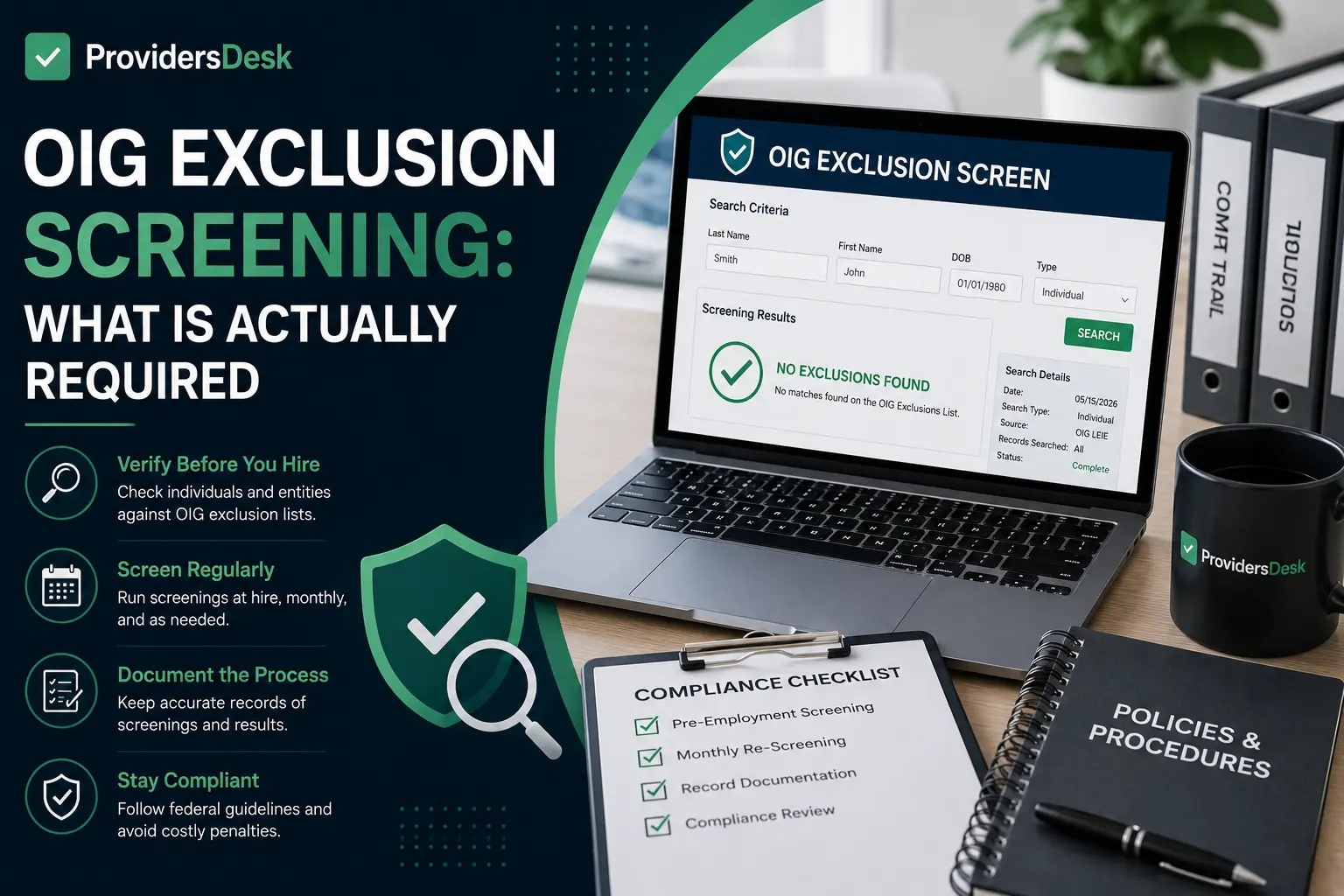
You will read a lot of content telling you that monthly exclusion screening is federally required. That is not quite true, and the real answer is more useful.
Understanding the difference between what is mandated, what is recommended, and what courts treat as reasonable diligence is what lets you build a program that actually protects you rather than one that just looks busy.
What an exclusion is
The OIG can bar an individual or an organization from participating in federal health care programs. Once excluded, no federal program will pay for any item or service that person furnishes, orders, or prescribes.
Some exclusions are mandatory, meaning the OIG has no discretion. A conviction for program-related fraud or patient abuse produces one automatically. Others are permissive, where the OIG weighs the circumstances.
Two details that surprise people. Exclusions take effect when imposed and are not paused while an appeal runs. And reinstatement is not automatic when the exclusion period ends. The person has to apply for it, and until they do, they remain excluded.
The scope is wider than most practices assume
The common assumption is that this applies to clinicians. It does not.
The prohibition covers any item or service that contributes to a federally billed claim. That reaches the billing clerk, the coder, the scheduler, the transcriptionist, and the person who cleans the exam rooms. If their work forms part of what you billed, an exclusion creates liability.
It also reaches beyond your payroll. Contractors, temporary staff, agency placements, and vendors all count. A billing company you outsource to is squarely inside the scope, and so is a locum agency.
Worth checking today: does anyone screen the staff at the companies you outsource to? Most practices screen their own employees and have never asked the question of a vendor. The liability does not care which payroll someone sits on.
The frequency question, answered honestly.
Here is what is actually true, separated into three categories that get blurred together constantly.
What is mandatory
There is no single federal statute that says every provider must screen every month. What exists is a penalty for employing an excluded person, and that penalty applies whether or not you knew.
What OIG recommends
The OIG Special Advisory Bulletin on the effect of exclusions recommends screening monthly. The bulletin shifted the expectation from annual to monthly, and that recommendation is the origin of the industry standard everyone now cites as a rule.
What actually determines your exposure
The penalty statute uses a knows or should know standard. Actual knowledge is not required. An organization acting in deliberate ignorance or reckless disregard of someone’s status is liable.
That is the sentence that matters. Not screening at all is difficult to distinguish from reckless disregard. Screening once at hire and never again is better, and still leaves years of exposure, because a person clean on their start date can be excluded the following month.
So monthly is not a rule you can point to in the code. It is the frequency that makes a reasonable diligence argument straightforward, which is why it became the standard. Some state Medicaid programs do mandate it outright, so check your own state before deciding otherwise.
Three lists, not one
Screening only the LEIE is the most common gap in otherwise decent programs.
| List | Who maintains it | Why you need it |
| LEIE | HHS OIG | The primary federal health care exclusion list |
| SAM | GSA | Government-wide debarment, broader than health care and not duplicated in the LEIE |
| State Medicaid | Each state | States exclude people the OIG has not, and many require you to check |
The state lists are the ones practices skip, usually because there is no single place to check them and every state publishes differently. If you operate in more than one state, you need each of them.
The LEIE is free and searchable at exclusions.oig.hhs.gov. The full downloadable file is published there too, refreshed monthly, which is what you want if you are screening more than a handful of names.
About the penalty figures you will read
Every article on this subject quotes a dollar amount. Search for a few, and you will find several different numbers, all published in the same year, all presented as current.
They disagree because the figure adjusts for inflation every year. The statutory base is twenty thousand dollars per item or service, set by the Bipartisan Budget Act of 2018, and it has been climbing annually since. Recent adjusted figures sit above twenty-five thousand.
Do not trust the number in any article, including this one. Check the current Federal Register inflation adjustment before you quote a figure to anyone. A number that was correct when an article was written is wrong by the following January.
What does not change is the structure of the exposure, and the structure is worse than the headline number suggests.
- The penalty is per item or service, not per person. One excluded employee over six months is hundreds of separate calculations.
- Treble damages apply on top, up to three times the amount claimed, with no ceiling.
- Everything billed becomes an overpayment and is repayable regardless of penalties.
- The practice itself can be excluded, which for most organizations is not survivable.
What to document
Screening you cannot prove is screening you did not do, as far as an auditor is concerned. The evidence matters as much as the check.
- The date you ran it
- The exact names and identifiers you searched
- The result for each one, including the negatives
- Which lists you checked, not just that you screened
- Who performed it
Keep the negative results. They are the entire point. A file of clean screening records is what demonstrates reasonable diligence, and a program that only records hits has no evidence of the months when nothing was found.
The name matching problem
Common names produce false positives constantly, and the LEIE holds tens of thousands of entries. A search for a common surname will return matches that are not your employee.
Resolve them using date of birth, National Provider Identifier, or Social Security number, and document how you resolved each one. An unresolved potential match sitting in a file is worse than not having searched, because it shows you were on notice and did nothing.
An NPI is useful for confirming identity here, but it proves nothing about exclusion status on its own. That distinction is covered in NPI Type 1 vs Type 2, which explains why having a number is not the same as being eligible to bill.
If you find someone
Stop billing for anything involving that person immediately. Every claim already submitted during the exclusion period is an overpayment, and retaining a known overpayment carries its own liability under the False Claims Act.
The OIG operates a Self-Disclosure Protocol for exactly this situation. Voluntary disclosure generally produces better outcomes than discovery during an audit, and the protocol includes a defined damages calculation rather than an open-ended negotiation.
This is the point to involve counsel rather than working it out internally. The calculation of what is owed, and how the disclosure is framed, has consequences that a billing department is not equipped to weigh.
What to do next
- List everyone whose work touches a federally billed claim, including administrative staff
- Add every contractor, agency, and vendor to that list
- Check whether your state Medicaid program maintains its own exclusion list and whether it mandates a frequency
- Screen the LEIE, SAM, and applicable state lists, then keep the results, including the clean ones
- Ask your outsourced billing company and staffing agencies how they screen their own people, and get the answer in writing
Sources
- OIG LEIE search and downloadable file. Free, authoritative, refreshed monthly.
- OIG exclusions program. Includes the Special Advisory Bulletin on the effect of exclusions.
- SAM.gov. Government-wide debarment records.
- OIG Self-Disclosure Protocol. What to do if you find an exclusion.
- Your own state Medicaid agency, which is the only authority on its own list and its own requirements.
Reference information only. Not legal or compliance advice. Exclusion liability carries serious financial and legal consequences, and decisions about screening programs or self-disclosure should involve qualified counsel.
Related guides
Type 1 belongs to a person, Type 2 belongs to a business. Easy enough until you hit the sole proprietor questi...