UnitedHealthcare Timely Filing Limits for 2026, by Plan Type
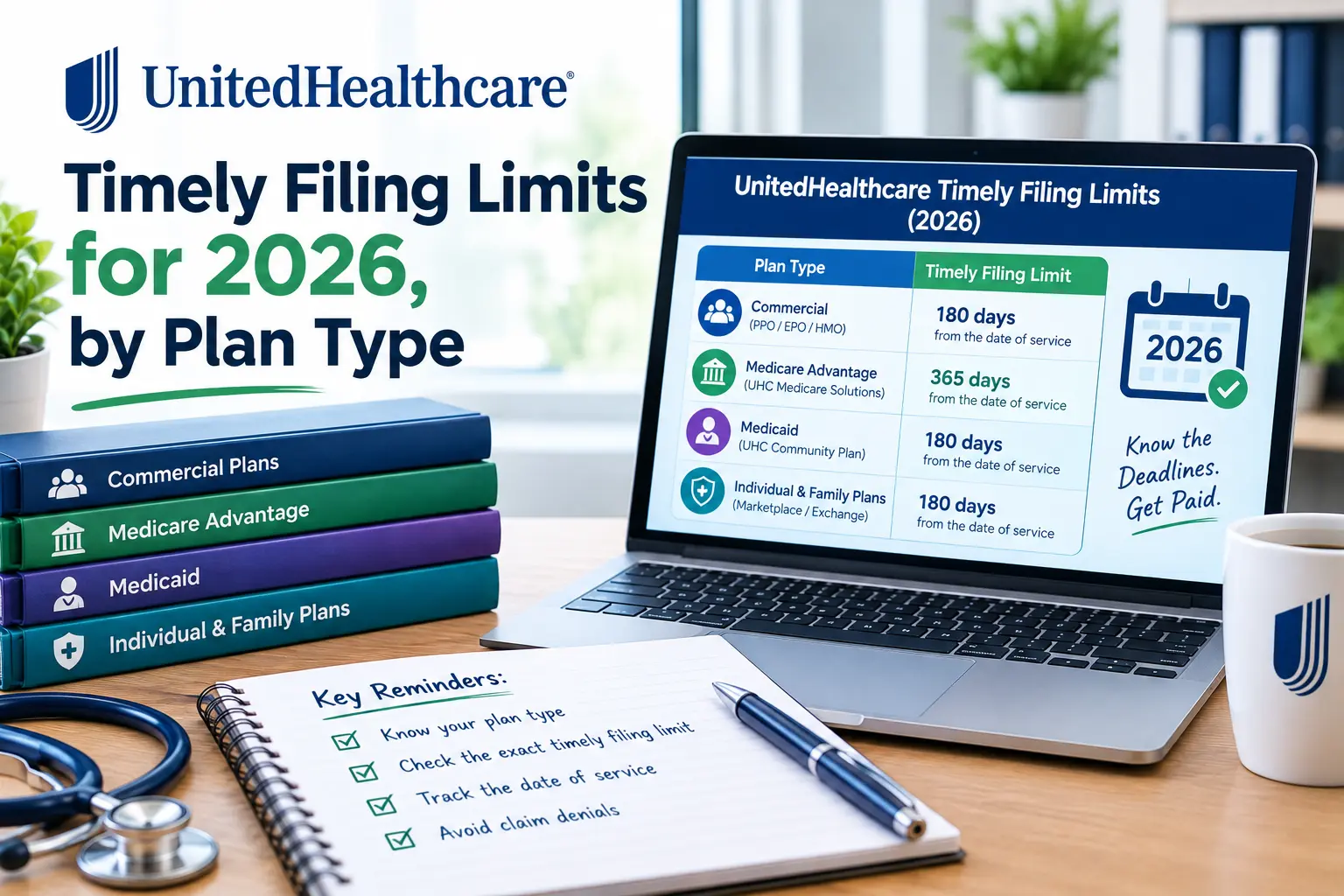
Most sites say UnitedHealthcare gives you 90 days to file. Its own 2026 guide sends you to your contract instead, and the 90 days on its website is an example. What UHC does publish is which clock each plan runs, and a corrected claim can be late on one of those clocks while it would be on time on another. Here is each one, quoted from UHC, Optum and UMR.
Search for the UnitedHealthcare timely filing limit, or TFL, and most answers give you one number, usually 90 days.
UnitedHealthcare’s own guide does not. Its 2026 administrative guide covers commercial, Individual Exchange and Medicare Advantage plans, and it answers the question in a single line: “Refer to your internal contracting contact or Participation Agreement for timely filing information.”
So the number of days lives in your contract. What UnitedHealthcare does publish is which clock each part of the company runs, and that matters as much as the number. A claim can be sent within the right number of days and still be late, because the days were counted from the wrong date.
Here is what each part of UnitedHealthcare says, quoted from its own documents.
The short version
| Plan | New claims | Corrected claims |
| Commercial, Exchange and Medicare Advantage | Your Participation Agreement sets the days, counted from the date of service, discharge or final outpatient visit | Inside the original window, per UHC’s claim correction page |
| Community Plan (Medicaid) | Set state by state. Indiana: 90 days. New Jersey: 180 days, or your agreement | Set state by state. Wisconsin: 180 days from the original remittance |
| Optum behavioral health | 90 calendar days from the date of service | Within 90 days of Optum receiving the first claim |
| UMR | The employer’s plan and your contract | Not stated. Mark it with frequency code 7 |
Commercial, Exchange and Medicare Advantage: your agreement sets the days
The 2026 guide took effect April 1, 2026 for providers already in the network. For providers who joined on or after January 1, 2026, it applied from the start.
UnitedHealthcare’s page on claim corrections says what the clock runs from. Your agreement requires all claim information, corrected claims included, within the required number of days after the date of service, discharge or final outpatient visit.
Then it gives an example. If the last date of service is May 1 and your agreement allows 90 days, UnitedHealthcare must receive all claim information, including corrections, by July 30.
Many websites quote 90 days as the UnitedHealthcare limit. On UnitedHealthcare’s own page, 90 days is an example of what an agreement might allow, not a rule. Yours may say 90 days, or something else.
Oxford’s commercial plans have their own supplement in the same 2026 guide, starting on page 297. Oxford’s level funded plans in Connecticut, New Jersey and New York have another, from page 347. If you bill Oxford, read its supplement next to your agreement.
UHC corrected claim timely filing: no new clock
Read that example again. The correction has to arrive by July 30 too.
The page does not split this rule by plan type, so plan on it for commercial, Exchange and Medicare Advantage corrections alike.
According to UHC’s claim correction page, a corrected claim does not start a fresh window when the original pays or denies. It has to land inside the window the original was in. If the original paid on day 80 of a 90 day window, you have ten days left to correct it. A correction that waits two weeks in a work queue can expire before anyone opens it.
UnitedHealthcare’s announcement of the 2026 guide lists one change to its claims chapter. Chapter 10 was “Revised and includes an update to timely filing requirements for corrected claims.” The announcement does not say what the update is. If you correct UHC claims often, read the section called Corrected (replacement) claim submissions in Chapter 10, next to your agreement. If it now gives corrected claims a window of their own, follow it.
UnitedHealthcare’s own tips for a correction that does not bounce:
- Wait for the original to finish processing before you send the correction.
- Use frequency code 7 and the original claim number.
- Include every service from the original, “not just the line you’re correcting.” The corrected claim replaces the original, and UHC says leaving services off “will result in an overpayment recovery of the excluded services.”
- Keep the same bill type. In UHC’s words, “A claim with a different bill type than the original is not a corrected claim.”
UHC secondary claim timely filing
UnitedHealthcare’s claim correction and EDI pages give commercial secondary claims no separate window. The claim correction page says all claim information is due within your agreement’s days “after the date of service, discharge or final outpatient visit.” The EDI tips cover how to send a secondary claim, not when.
So unless your agreement or the 2026 guide says the days run from the primary payer’s EOB, count them from the date of service and bill the primary payer quickly. A slow primary payer can use up most of the UHC window before the secondary claim can go out.
What UHC’s EDI tips do say:
- Send the primary payer’s results in the claim. For a secondary claim to pay electronically, the coordination of benefits information must be in “the applicable loops and segments.” Sent that way, UHC does not need the paper EOB.
- Report it line by line. Include the primary paid amount for each service line, and the adjustment group and reason codes as they appear on the primary payer’s 835.
- Look for MA18 when Medicare is primary. UHC suggests allowing 15 to 20 days for Medicare’s EOB. Remark code MA18 means Medicare already sent the claim on to the secondary payer, so UHC asks you not to send it again.
Medicaid is different. UnitedHealthcare’s Community Plan guides do give secondary claims a window, counted from the primary payer’s EOB. Indiana allows 90 days. New Jersey allows 60 days from the primary EOB or 180 days from the date of service, whichever is later. Both are in the Community Plan table below.
UHC appeal timely filing: 12 months for both steps
For a claim decision you disagree with, UnitedHealthcare’s appeals page sets out two steps, except where the law says otherwise. First a claim reconsideration. Then, if you still disagree, an appeal.
Its timing line reads: “You have 12 months to complete the following steps.” That covers both steps together.
The page does not say where the 12 months start. The same page also says “Timelines vary” and points back to your Participation Agreement. Until your agreement says otherwise, count from the earliest date it could mean.
Send them electronically. UHC’s appeals page says most network providers must submit reconsiderations and appeals digitally for commercial, Medicare Advantage and Community Plan members. For claim appeals on commercial and Medicare Advantage plans, that became a requirement on February 1, 2026, through the UnitedHealthcare Provider Portal or its API. UHC’s notice lists exceptions, including behavioral health, UMR and its Colorado plans.
A timely filing denial goes through the same two steps, and it is won with proof that UHC received the claim on time. That proof is the 277CA, not the 999 from your clearinghouse, as the timely filing proof post explains. The CO-29 post covers how to work the denial itself.
Medicare Advantage without a contract
If you treat a UnitedHealthcare Medicare Advantage member without a contract, a separate UHC document sets your deadlines.
- Payment dispute. For when you believe Original Medicare would have paid differently for the same service. File within 120 calendar days from the initial payment.
- Payment reconsideration. For a denied claim, or when UHC paid for a different service or level of service than you billed. File within 60 days from the denial date, with a Waiver of Liability statement.
UHC counts those 60 days from the denial date. The federal rule for Medicare Advantage reconsiderations, 42 CFR 422.582, counts 60 days from when you receive the written decision, which is presumed to be five days after its date. File inside UHC’s count and you are inside both.
That document gives no filing limit for the original claim. If you see UHC Medicare Advantage members without a contract, ask UnitedHealthcare which limit applies before the first claim goes out.
Community Plan: the state picks the clock
Community Plan is UnitedHealthcare’s Medicaid business. Each state contract sets its own rules, so UnitedHealthcare publishes them state by state. Three of its state guides show how far apart they sit.
| State | New claims | Reconsideration | Also in the guide |
| Indiana | Professional claims: 90 calendar days from the date of service | 90 calendar days from the original EOB date | Secondary claims: 90 days from the primary EOB |
| New Jersey | 180 days, or the time frame in your agreement | Within 90 days of UHC’s determination date | Secondary claims: 60 days from the primary EOB or 180 days from the date of service, whichever is later |
| Wisconsin | The time frame in your agreement. Out of network: 365 days from the date of service | 60 calendar days from the original remittance date | Corrected claims: 180 calendar days from the original remittance date |
Texas Medicaid adds a fourth answer: a reconsideration within 120 days of the claim’s decision date, and an appeal within 12 months from the date of service. Across these four states, reconsideration windows alone run 60, 90 and 120 days.
Now put Wisconsin’s corrected claim rule next to the example on UHC’s claim correction page. In Wisconsin Medicaid, a correction gets 180 days from the original remittance. Under that example, it gets no new clock at all. Same company, opposite answers.
Each guide is dated in its footer. Check the date before you rely on any of them, this table included. For a state not listed here, find your state’s Community Plan manual on UHCprovider.com.
Optum behavioral health: a third clock
Behavioral health claims for UnitedHealthcare members often go to Optum, which runs the behavioral health network for many UHC plans. Optum’s provider site, Provider Express, sets its own timing.
All information needed to process a claim must reach Optum “no later than 90 calendar days” from the date of service. Corrections or additions “should be made within 90 days of receipt of the initial claim.”
That correction clock starts on the day Optum received your first claim. Not the date of service, and not the remittance. If you bill behavioral health H codes for UHC members, find out which clock your claims are on before you correct one.
The Optum behavioral health timely filing post works through both clocks with a dated example, plus how to send a correction, what proves a claim was on time, and Optum’s appeal windows.
UMR: the employer writes the rule
UMR is a UnitedHealthcare company, but it is not an insurance company. It administers health plans that employers pay for themselves.
Its FAQ for providers says timely filing requirements come from that employer’s plan and from your own contract, and can vary with either. So there is no single UMR timely filing limit. Check the member’s plan through UMR, and check your agreement.
If UMR denies a claim as late, the FAQ says you must send proof that you filed within the limit. For a corrected claim, it asks for resubmission code 7 in box 22 of a professional claim, or bill type XX7 in box 4 of a facility claim.
How to find the limit for one UMR plan, and the 180 day appeal rule for members, is in the UMR timely filing post.
Before you file with any UnitedHealthcare plan
- Find out which part of UnitedHealthcare will process the claim: commercial, Medicare Advantage, Community Plan in which state, Optum or UMR.
- Get the number of days from the document that governs it: your agreement, the state guide, or the employer’s plan.
- Write down what the clock runs from. The date of service, the remittance, the primary payer’s EOB, or the day the first claim arrived.
- If UHC is secondary, send the primary payer’s results in the COB loops, and skip any Medicare claim marked MA18.
- For corrections, check whether they get a new window. On UHC’s claim correction page, they do not.
- Keep the 277CA for every claim. It is what wins the dispute if UHC says you were late.
Where these denials and adjustments show up on the remittance is covered in how to read an ERA.
Sources
- 2026 UnitedHealthcare Care Provider Administrative Guide for Commercial, Individual Exchange and Medicare Advantage.
- UnitedHealthcare, Your 2026 Provider Administrative Guide is ready, January 2026.
- UnitedHealthcare, Reduce claim returns and rework.
- UnitedHealthcare, Avoid claim rejections and denials, February 2025.
- UnitedHealthcare, appeals and reconsiderations.
- UnitedHealthcare, electronic claim appeals required from February 1, 2026.
- UnitedHealthcare, EDI quick tips for claims.
- UnitedHealthcare Medicare Advantage, dispute and appeal rights for care providers without a contract, 2025.
- 42 CFR 422.582, request for a standard reconsideration.
- UnitedHealthcare Community Plan of Indiana, claims presentation, 2025.
- UnitedHealthcare Community Plan of New Jersey, quick reference guide, 2026.
- UnitedHealthcare Community Plan of Wisconsin, time frames for claim submissions and appeals, 2025.
- UnitedHealthcare Community Plan, Texas Medicaid claims reconsideration guide, 2025.
- Optum Provider Express, claim tips.
- UMR, questions answered for providers, 2024.
Reference information only. Not billing advice. UnitedHealthcare filing limits are set by contract, by plan and by state, and its documents change. Verify against your Participation Agreement and the current guide before you file, correct or appeal a claim.
Related guides
Aetna gives out of network providers 12 months to file medical claims. In network, its provider manual points...
Cigna Healthcare gives participating providers 90 days after the date of service to file a claim, and out of n...
CO-253 isn’t a denial. It’s Medicare’s 2 percent sequestration cut, taken from Medicare’s payment after the de...