Timely Filing Limits by Payer, With the Correction and Appeal Clocks
Every claim runs on three clocks: filing, correction and appeal. Here they are side by side for Medicare, Cigna, Aetna, UnitedHealthcare, Oxford, Optum, UMR and VA Community Care, with the New York, New Jersey and Texas laws and one visit worked through every limit.
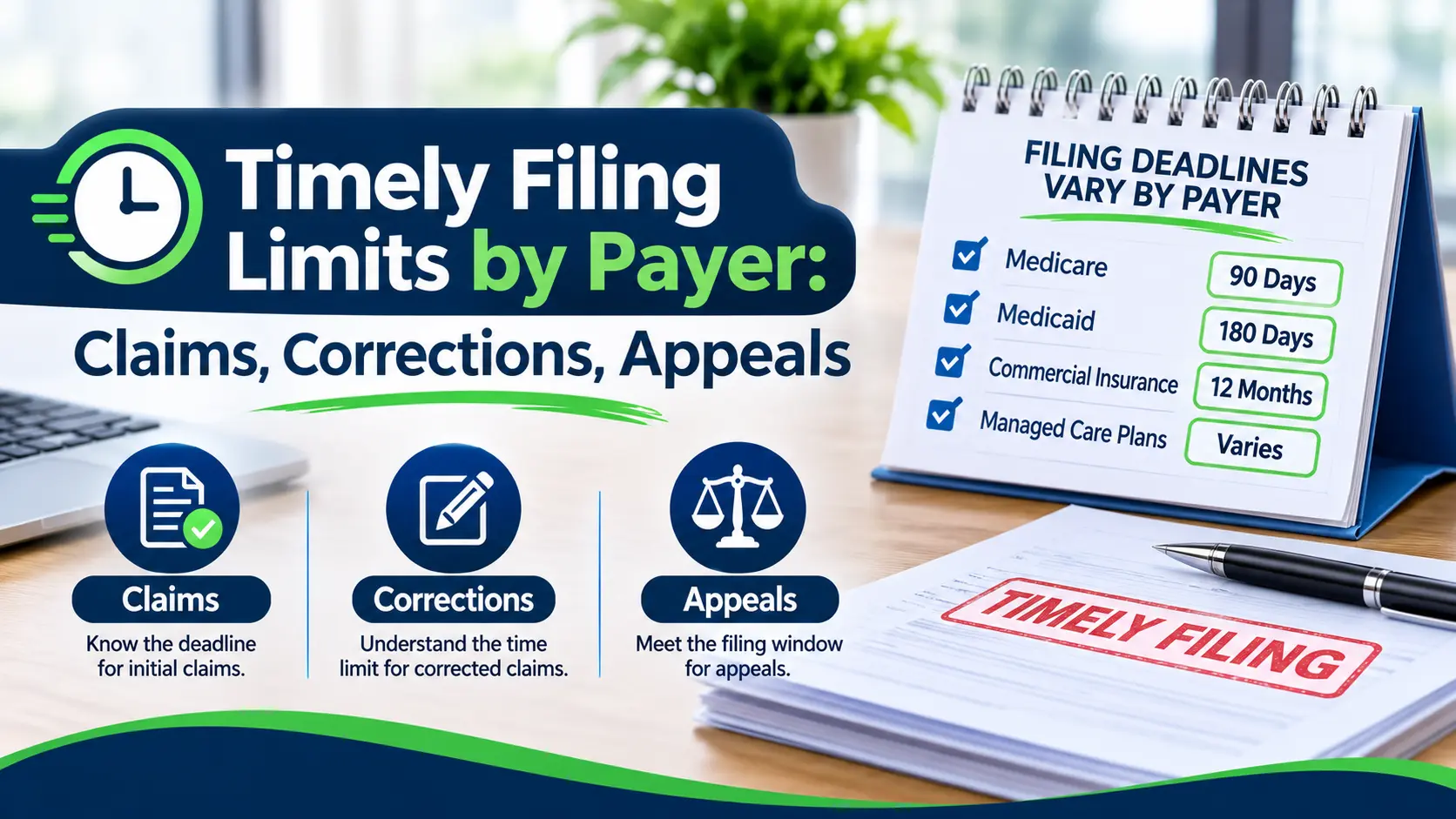
Every claim runs on three clocks: one to file it, one to correct it and one to appeal it. Each payer sets all three, and they don’t always start on the date of service.
This page puts them side by side for Medicare, Cigna, Aetna, UnitedHealthcare, Oxford, Optum, UMR and VA Community Care. Every number comes from the payer’s own documents or the law behind them, rechecked on November 4, 2026. Each payer with a guide links to it, and the calculator at the end turns any of these into dates.
One rule comes first: your contract wins. Aetna and UnitedHealthcare don’t publish a filing limit for providers in their commercial networks. Both send you to your agreement.
Filing limits by payer
| Payer | Filing limit | Counted from |
| Original Medicare | 12 months | The date of service |
| Cigna, in network | 90 days | The date of service. For a hospital stay or other consecutive days, the last one |
| Cigna, out of network | 180 days | The same |
| Aetna, in network | Your agreement | Your agreement |
| Aetna, out of network | 12 months, for medical claims | Not stated. Count from the date of service |
| UnitedHealthcare | Your Participation Agreement | The date of service, discharge or final outpatient visit |
| Oxford Health Plans | State law on fully insured plans. Your agreement on Level Funded plans | See the state laws below |
| Optum Behavioral Health | 90 calendar days | The date of service |
| UMR | The employer’s plan and your contract | Not stated |
| VA Community Care Network | 180 days | The date the care was given |
Medicare’s limit is set by federal regulation: 1 calendar year after the date of service. VA’s comes from federal law, which gives 180 days after the care was given.
Where a row says “your agreement,” it means it. If you can’t find the number in your contract, ask the payer to confirm it in writing before you rely on any number from the web.
State laws that set the clock
Some states write the filing limit into law for fully insured plans, whatever the payer. Three matter for the payers on this page.
| State | Filing limit | What else the law says |
| New York | 120 days after the date of service. Your agreement can give you longer | A participating provider can ask again for a claim denied only as late. If you qualify, it’s paid, minus up to 25 percent. The right ends 365 days after the date of service |
| New Jersey | 180 days from the last date of service of the course of treatment, for claims filed under an assignment of benefits | Miss it, and the plan may deny the claim. Then you can’t bill the patient for it |
| Texas | 95 days after the date of service, on preferred provider plans. A contract can extend it | Miss it, and the provider “forfeits the right to payment” |
These laws bind insurers and HMOs. Under ERISA, a private employer’s self funded plan isn’t treated as an insurer under state insurance laws, so they generally don’t reach those plans. Check how a plan is funded before you count on its state’s clock.
Oxford’s fully insured plans in New York and New Jersey follow the first two, and Aetna’s Texas and New York limits come from the same laws. The Oxford guide covers the New York late claim right in full.
Corrected claims: usually no new clock
This is where claims filed on time get lost. Most payers give a correction no window of its own, so it has to arrive inside the original filing limit.
| Payer | Correction window |
| Cigna | The same clock. A resubmission Cigna didn’t ask for is still held to the filing limit |
| Aetna | No window of its own. Treat it as due inside your original filing limit |
| UnitedHealthcare | Inside the original window. All claim information, corrections included, is due by the same day |
| Oxford | No state law gives a correction its own window. Check the claims section of Oxford’s supplement |
| Optum Behavioral Health | 90 days from the day Optum received the first claim |
| UMR | No window published. Mark the claim as a correction: resubmission code 7 on a professional claim, bill type XX7 on a facility claim |
Optum is the one that catches people. Its correction clock starts when Optum receives the first claim, not on the date of service and not when the claim pays.
Medicare handles fixes differently, through reopenings and adjustment claims. The CO-29 guide covers both.
Appeals: one step or two
| Payer | Appeal deadlines |
| Original Medicare | Redetermination within 120 days of receiving the initial determination. Medicare presumes you received it 5 days after its date. Later levels have their own deadlines |
| Cigna | Appeal within 180 calendar days of the initial payment or denial notice |
| Aetna | Reconsideration within 180 calendar days of the claim decision, then an appeal within 60 calendar days of the reconsideration decision |
| UnitedHealthcare | A reconsideration, then an appeal: 12 months to complete both |
| Oxford | Its own section in Oxford’s supplement. In New York, the late claim right for claims denied only as late |
| Optum Behavioral Health | It depends on the plan. See the Optum guide |
| UMR | On employer plans under ERISA, the member gets at least 180 days after receiving the denial |
| Aetna Medicare Advantage, no contract | Straight to appeal, within 65 days |
Aetna’s second clock is the one to watch. It’s a third the length of the first, and it runs from the date of the reconsideration decision.
UnitedHealthcare’s appeals page doesn’t say when its 12 months start. Until your agreement says otherwise, count from the earliest date it could mean.
One visit, every deadline
Here is one visit on Monday, November 16, 2026, under each limit:
| Limit | Last day to file |
| 90 days: Cigna in network, Optum Behavioral Health | Sunday, February 14, 2027 |
| 95 days: Texas law | Friday, February 19, 2027 |
| 120 days: New York law | Tuesday, March 16, 2027 |
| 180 days: Cigna out of network, VA, New Jersey law | Saturday, May 15, 2027 |
| 12 months: Medicare, Aetna out of network | Tuesday, November 16, 2027 |
Two of those dates fall on a weekend. Don’t count on an extra day. File by the Friday before.
Secondary claims
When another plan pays first, Cigna counts the limit from the processing date on the primary payer’s EOB or EOP. New York’s 120 day law keeps any extra time the state’s coordination of benefits rules already gave.
For the rest, each guide has the details. Either way, bill the primary payer quickly. On a clock that starts with the date of service, its delay comes out of your window.
Turn a limit into dates
Our timely filing calculator counts every rule on this page, and flags a deadline that lands on a weekend or a holiday. Open it with your payer already chosen:
- Original Medicare
- Cigna, in network or out of network
- Aetna, in network, out of network, Texas or New York
- UnitedHealthcare
- Optum Behavioral Health
- UMR
- VA Community Care Network
- Any other payer, Oxford included: enter 120 days for New York, 180 for New Jersey, or the number in your agreement
Proof wins a late denial
A claim a payer calls late comes back as CO-29. What wins it back is proof the payer received the claim on time: the 277CA from the payer, not the 999 from your clearinghouse. The proof of timely filing guide explains the difference, and the CO-29 guide covers working the denial.
UMR puts it plainly. To dispute a timely filing denial, “the provider must submit proof they filed the claim within the timely filing limits.”
Medicaid plans set their own
Each state’s Medicaid plans publish their own limits. The Aetna guide covers Aetna Better Health in Illinois, Kentucky and Louisiana, and the UnitedHealthcare guide covers its Community Plan in Indiana, New Jersey and Wisconsin. The calculator has all six.
Sources
- 42 CFR 424.44, time limits for filing Medicare claims.
- CMS, First level of appeal: redetermination by a Medicare contractor.
- Cigna Healthcare, Claims submission, payments and filing.
- Cigna Healthcare, Appeals and disputes: how to submit.
- Aetna, Disputes and appeals overview, updated October 14, 2026.
- Aetna, Provider manual, June 2026 edition.
- Aetna, OfficeLink Updates, September 2021, copy published by the Maryland Department of Health.
- UnitedHealthcare, Reduce claim returns and rework, July 2026.
- UnitedHealthcare, Appeals and reconsiderations, July 2026.
- Optum, Provider Express claim tips.
- UMR, Questions answered for providers, UM1491.
- 29 CFR 2560.503-1, ERISA claims procedure.
- 38 U.S.C. 1703D, VA prompt payment standard.
- New York Insurance Law, Section 3224-a.
- N.J.A.C. 11:22-3.4, Health care providers; claims.
- Texas Insurance Code, Section 1301.102.
- 29 U.S.C. 1144, ERISA preemption of state laws.
Reference information only. Not billing advice. Filing limits change, and your contract, your state or the plan behind a card can set different ones. Confirm with the payer before you rely on a date.
Related guides
TRICARE claims get one year from the date of service in both regions. Here is where the year starts, the five...
Federal law gives VA community care claims 180 days. After that, it depends on who gets the claim: Optum in Re...
Oxford Health Plans is part of UnitedHealthcare, with its own supplements in UHC’s 2026 guide. For fully insur...