Medicare Advantage Timely Filing Limits: With a Contract and Without One
The one year limit belongs to Original Medicare. A Medicare Advantage plan runs on your contract’s clock, or on its own rule if you have no contract. Humana, Aetna and UnitedHealthcare side by side, with the 60 day appeal and the waiver.
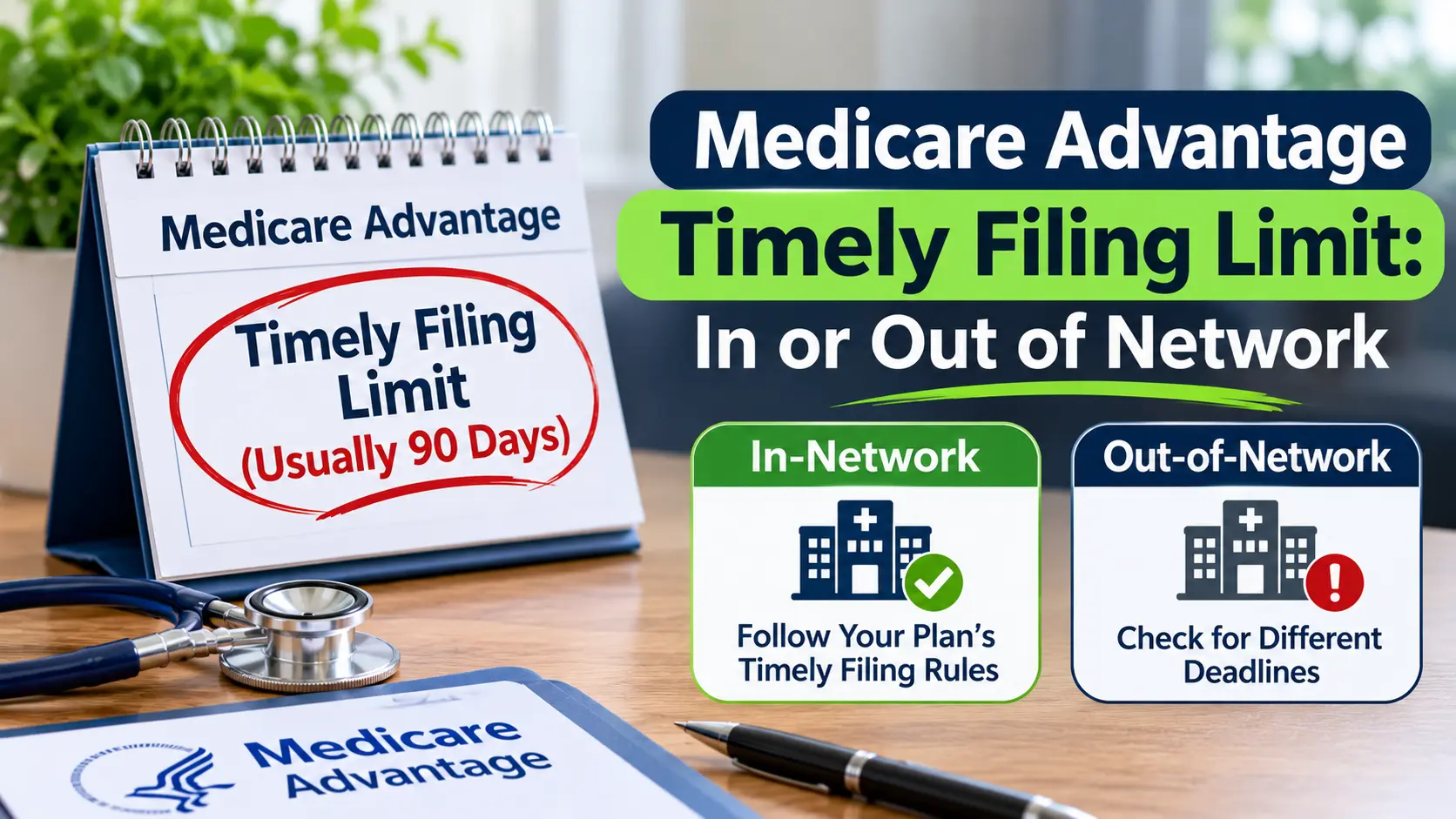
The one year limit everyone quotes belongs to Original Medicare. Federal regulation gives a Medicare claim until “1 calendar year after the date of service.”
A Medicare Advantage plan doesn’t have to follow it. The plan is run by a private company that CMS pays, and its claims run on their own clock: the one in your agreement if you have a contract, and the plan’s own rule if you don’t.
This guide sets out both, for Humana, Aetna and UnitedHealthcare. It also covers the part federal rules do fix, the appeal deadline, and how corrections work. Everything comes from the federal rules or the plans’ own documents, checked on November 16, 2026.
The short answer
Which rule applies depends on who pays and whether you have a contract:
| Situation | Filing limit | Where it comes from |
| Original Medicare | 1 calendar year from the date of service | Federal regulation, 42 CFR 424.44 |
| Medicare Advantage, with a contract | The number in your agreement | Your agreement, then the plan’s manual |
| Humana Medicare Advantage, no contract | 1 year from the date of service | Humana’s 2026 provider manual |
| Aetna Medicare Advantage, no contract | 12 months | Aetna’s standard for out of network medical claims |
| UnitedHealthcare Medicare Advantage, no contract | Not published for the first claim | Ask UnitedHealthcare before you bill |
Where the plans line up is the appeal. Count 60 days from the date printed on the denial notice, and send a signed waiver of liability with it. Both are explained below.
Why Original Medicare’s year doesn’t carry over
CMS does set rules for how Medicare Advantage plans treat providers without a contract. They cover money and paperwork, not deadlines:
- Payment. The plan must pay at least what Original Medicare would. In CMS’s words, providers without a contract “are required to accept as payment, in full” the amount they could collect if the patient had Original Medicare.
- Forms. Plans “must accept from providers the same billing forms used to bill original Medicare.”
- Coding edits. A plan paying Medicare rates must use rules “not more restrictive than the CCI edits or than the OCE.”
- Speed. Under 42 CFR 422.520, the plan pays 95 percent of clean claims from providers without a contract within 30 days, with interest after that. Every other claim from them must be paid or denied within 60 days.
None of these sets a filing deadline. So the deadline is the plan’s own, and the plans publish different ones.
You may read that CMS sets a 12 month floor for out of network claims. We couldn’t find that rule in the regulations or in CMS’s guide to out of network payments. Humana and Aetna do use a year, but go by each plan’s own number.
With a contract, there isn’t even a federal payment clock. The regulation only says the contract “must contain a prompt payment provision,” on terms the plan and the provider agree.
With a contract, your agreement decides
Start with the agreement. The plans’ own manuals point back to it:
- Humana. Its manual’s limits apply “if not otherwise specified by the agreement or applicable state or federal law.” For Medicare plans, that limit is “1 year from date of service.”
- UnitedHealthcare. Its 2026 administrative guide covers Medicare Advantage and answers in one line: “Refer to your internal contracting contact or Participation Agreement for timely filing information.”
- Aetna. For its Medicare Advantage plans, a contracted provider’s filing limit is in the agreement. The claims pages of its provider manual give no number of their own.
So don’t assume Medicare’s year. A claim sent on day 120 is on time for Original Medicare and late under an agreement that allows 90 days.
Disputes run on the contract’s clock as well. Humana’s manual allows a dispute “within 18 months from the date the provider received notice of the original claim determination,” unless your agreement or the law sets another period.
Aetna gives contracted providers two levels, a reconsideration and then an appeal. Their Medicare appeals go to Medicare Provider Appeals, PO Box 14835, Lexington, KY 40512.
UnitedHealthcare wants appeals online. Since February 1, 2026, most network providers must send claim appeals for its commercial and Medicare Advantage plans through its provider portal or its API, with some exceptions.
Without a contract, the plan’s rule
First check that the plan pays for care from you at all. Medicare’s own guide tells HMO members, “You generally must get your care and services from providers and facilities in the plan’s network,” except for emergency or urgent care and dialysis outside the plan’s area.
PPO members may go out of network and pay more. A Private Fee for Service plan covers any Medicare provider that accepts its payment terms.
Then the deadlines. Each plan sets its own:
| Plan | Claim filing limit | Appeal of a denial | Where the appeal goes |
| Humana | 1 year from the date of service | 65 calendar days from the date of the denial notice | Humana Grievance and Appeal Department, PO Box 14165, Lexington, KY 40512 |
| Aetna | 12 months | 65 days on its appeals page. Its 2021 guide says 60 days from the date of the denial notice | Aetna Medicare Part C Appeals, PO Box 14067, Lexington, KY 40512 |
| UnitedHealthcare | Not published for the first claim | 60 days from the denial date | The UnitedHealthcare Provider Portal |
Aetna’s 12 months is its standard for out of network medical claims. It replaced the old 27 months on January 1, 2022, to “Match Centers for Medicare & Medicaid Services (CMS) standards.” The notice doesn’t single out Medicare Advantage, and Aetna’s guide for out of network Medicare providers gives no other number.
UnitedHealthcare’s document for providers without a contract sets the appeal and dispute windows but no limit for the first claim. Ask UnitedHealthcare which one it applies before that claim goes out, and keep the answer.
Denied or underpaid: two different doors
Medicare Advantage plans sort what you disagree with into two kinds, and each has its own process:
- A denial, or a different service than you billed. That’s an appeal, a reconsideration under federal rules. UnitedHealthcare’s document sends you there “If you disagree with a denied claim or if we paid for a different service or level of service than what was billed.”
- The amount. If you think Original Medicare would have paid more for the same service, that’s a payment dispute, not an appeal. UnitedHealthcare allows 120 calendar days from the initial payment. Aetna sends disputes over “the amount you can collect if the beneficiary were in Original Medicare” to its payment dispute process.
If the plan’s dispute process doesn’t settle the amount, CMS says you “may file a complaint through 1-800-Medicare.” Its guide adds that CMS “does not offer advice to providers on their potential rights in a payment dispute.”
When the denial is for medical necessity, the plan has to use Medicare’s coverage rules. Our CO-50 guide shows how to argue that.
The appeal clock: 60 days from the notice
Here federal rules do set the deadline. A reconsideration “must be filed within 60 calendar days” after you receive the plan’s written decision. Receipt is presumed “to be 5 calendar days” after the date on it, unless there is evidence otherwise.
That explains why the plans’ numbers differ. Humana says 65 days from the date of the denial notice, which is the 60 plus those 5, and Aetna’s appeals page also says 65 days. UnitedHealthcare counts 60 days from the denial date, and Aetna’s 2021 guide says 60 days from the date of the denial notice.
So count 60 days from the date printed on the notice, and you’re inside every version. A denial dated Monday, December 7, 2026, is safe until Friday, February 5, 2027. The 65 day count runs to Wednesday, February 10.
And count to when the plan receives it, not when you send it. The rule treats a request as filed “on the date it is received by the plan or delegated entity.”
The waiver of liability
Without a contract, you appeal as the patient’s assignee. The regulation describes that as a provider who furnished the service “and formally agrees to waive any right to payment from the enrollee.”
In practice that means a signed Waiver of Liability statement, and all three plans ask for one. Humana says providers appealing on their own behalf “must provide a signed copy of the Waiver of Liability Statement.”
Aetna dismisses the appeal if the signed form hasn’t arrived within 60 calendar days of the request. UnitedHealthcare lists it among the items an appeal must include.
The waiver means you won’t bill the patient for the service, whatever the outcome. Sign it knowing that.
If the plan says no again
You don’t file the next level yourself. When a plan upholds its denial, in whole or in part, it must send the case file to CMS’s independent review entity “no later than 60 calendar days from the date it receives the request.” The reviewer then writes to you directly. Aetna’s and UnitedHealthcare’s documents both describe this step.
Correcting a Medicare Advantage claim
With a contract, the agreement and the plan’s correction rules apply, and the clock usually doesn’t restart. UnitedHealthcare, for one, wants a corrected claim inside the original filing window. Our guide to submitting a corrected claim shows where the frequency code and the original claim number go on each form.
Without a contract, federal reopening rules apply to the plan’s decision. They follow Original Medicare’s: within one year of the decision for any reason, and within four years for good cause. A clerical error in a decision that went against you can be corrected at any time.
How a plan wants the fix sent, as a replacement claim or a reopening request, is its own rule. Check its manual before you send one.
Who runs the plan
Read the member’s card before you bill. The name on it isn’t always the company you’d expect:
- HealthSpring. Cigna sold its Medicare Advantage plans to Health Care Service Corporation, and the sale closed on March 19, 2025. The plans now carry the HealthSpring name and kept payer ID 52192. Our Cigna guide has the claims address.
- Humana. Medicare Advantage claims go to payer ID 61101, and Humana expects them electronically.
For the other payers, timely filing limits by payer puts them side by side.
Before the first claim goes out
- Check whether you’re in the plan’s network, and whether the member’s plan is an HMO, a PPO or Private Fee for Service.
- Find the filing limit: your agreement if you have one, and the plan’s published rule if you don’t.
- Keep the payer’s acceptance report, the 277CA, for every claim. It’s your proof of timely filing if the plan says you were late.
- For a denial: 60 days from the date on the notice, a signed waiver, and the right address or portal.
Our timely filing calculator does the date math for Humana Medicare Advantage. Enter the date of service and the decision date, and it gives the filing, dispute and appeal deadlines.
Sources
- 42 CFR 424.44, time limits for filing claims, Original Medicare.
- 42 CFR 422.520, prompt payment by MA organization.
- 42 CFR 422.574, parties to the organization determination.
- 42 CFR 422.582, request for a standard reconsideration, as amended April 23, 2024.
- 42 CFR 422.590, timeframes and responsibility for reconsiderations.
- 42 CFR 422.616, reopening and revising determinations, and 42 CFR 405.980, reopenings.
- CMS, MA Payment Guide for Out of Network Payments, April 15, 2015.
- CMS, payment dispute resolution for providers without a contract, updated September 10, 2024.
- Medicare.gov, Compare types of Medicare Advantage Plans, April 2026.
- Humana, 2026 provider manual for physicians, hospitals and healthcare providers.
- Humana, Information for non participating providers, February 2026.
- Aetna, Our Denial Appeals Process for Out of Network Providers, Medicare, 2021.
- Aetna, Disputes and Appeals Overview.
- Aetna, OfficeLink Updates, September 2021, copy published by the Maryland Department of Health.
- 2026 UnitedHealthcare Care Provider Administrative Guide, for commercial, Individual Exchange and Medicare Advantage.
- UnitedHealthcare Medicare Advantage, dispute and appeal rights for care providers without a contract, 2025.
- UnitedHealthcare, electronic claim appeals required from February 1, 2026.
Reference information only. Not billing advice. Medicare Advantage plans set their own claim rules, and your agreement can set different ones. Check the plan’s current documents before you file, correct or appeal a claim.
Related guides
A corrected claim needs frequency code 7, or 8 to void, and the payer’s original claim number. Where each goes...
Humana gives Medicare Advantage claims one year from the date of service, unless your agreement sets another l...
TRICARE claims get one year from the date of service in both regions. Here is where the year starts, the five...