Provider Tax ID Lookup: What the NPI Registry Will Not Show You
There is no free public lookup that turns an NPI into a tax ID. CMS planned to publish organizations’ EINs in 2007, then hid every nine digit number after some providers entered Social Security numbers as their corporation’s EIN. Here is where the tax ID goes on a claim, why payers match it to your NPI, and where to get one legitimately.
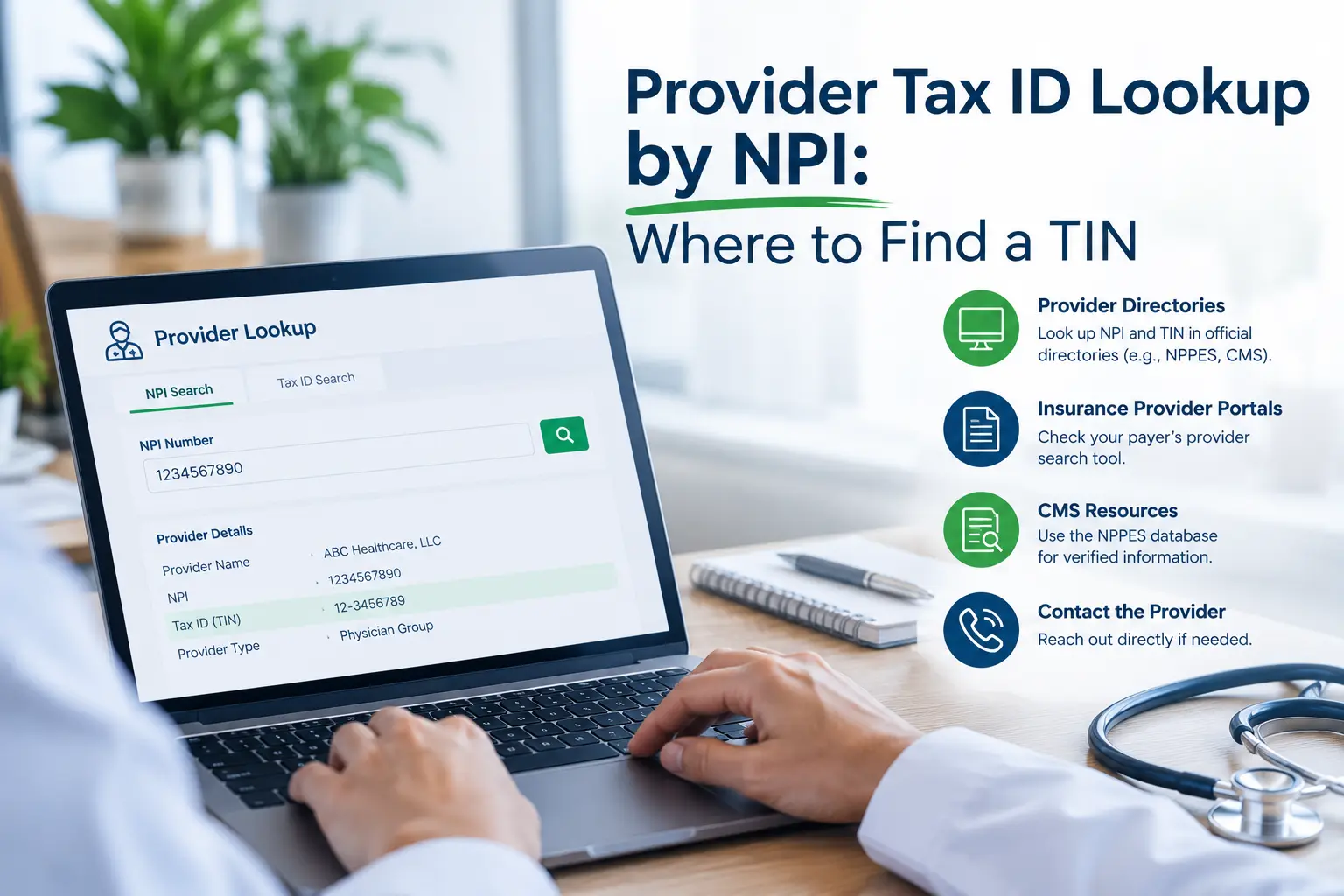
There is no free public lookup that turns a provider’s NPI into a tax ID. Not the NPI Registry, and not any other government site.
That is not an oversight. CMS decided it in 2007, and the reason tells you where to look instead.
Why the NPI Registry hides tax IDs
In June 2007, CMS published the list of NPPES data it would disclose. For organizations, the list included the Employer Identification Number, or EIN.
Then it found a problem. Some incorporated providers, applying for an NPI for their corporation, had reported their own Social Security numbers as the corporation’s EIN. CMS’s October 2007 notes on the public file describe “the temporary suppression of the EINs of all Organizations,” and add that “CMS expects to lift the suppression of EINs in the near term.”
A month later, CMS explained the rule it was using. Social Security numbers and EINs are both nine digits, and it could not tell them apart. So it hid every nine digit number in every field it published, except ZIP codes and phone numbers. Its own message admitted the cost: health plans using the registry could no longer see legitimate EINs.
The suppression never lifted. Nineteen years later, the EIN column is still in the public NPPES file, and it still holds no EINs. Our own NPI lookup is built from that file, so it cannot show tax IDs either.
Is an NPI the same as a tax ID?
No. They are two different numbers from two different agencies, and a claim carries both. Here is how they compare.
| NPI | Tax ID (EIN or SSN) | |
| Issued by | CMS, through NPPES | The IRS for an EIN, the Social Security Administration for an SSN |
| Length | 10 digits | 9 digits |
| What it identifies | The provider, in HIPAA standard transactions | The taxpayer the payments are reported under |
| Public | Yes, in the NPI Registry | Not in the registry. Some organizations’ EINs are public elsewhere |
| When a provider changes jobs | Stays the same | Often changes, because it follows the group they bill under |
What is a TIN for providers?
TIN stands for taxpayer identification number. It is the IRS’s name for the number your payments are reported under, and payers use TIN and tax ID to mean the same thing.
For a provider it is one of two numbers. A practice, group or other business has an EIN, which the IRS assigns. A clinician who bills as an individual, without an EIN, uses their own Social Security number.
Where the tax ID goes on a claim
On the paper claim form, the tax ID goes in box 25. The national instructions say to enter the federal tax ID, either an EIN or a Social Security number, “of the Billing Provider identified in Item Number 33.” They add the line that explains why payers care: “This is the tax ID number intended to be used for 1099 reporting purposes.”
Mark one box, SSN or EIN, never both. And the instructions say, “Do not enter hyphens with numbers.”
The NPIs sit elsewhere. Box 33a carries the billing provider’s NPI, and box 24J carries the rendering provider’s. A clinician in a group practice usually bills under the group’s tax ID and the group’s NPI, with their own NPI on the service line. The NPI type 1 vs type 2 post walks through who goes where.
On an electronic claim, the tax ID travels in the billing provider loop, 2010AA, marked EI for an EIN or SY for a Social Security number. One state Medicaid guide spells out the rule: when the NPI is sent, the EIN or the SSN must be sent with it.
The NPI and the tax ID must match what the payer has
Payers enroll the NPI and the tax ID together, so the pair on the claim has to match the pair on file. When it does not, the claim usually rejects before anyone reviews it.
An Indiana Medicaid plan’s rejection guide shows how plainly that reads: “Not enrolled with MHS with rendering NPI/TIN on DOS.” The fix it gives is to enroll that combination and resubmit.
This is why rejections tend to follow a provider who moves between groups. The NPI stays the same for life. The tax ID it bills under changes, and every payer has to be told.
Why payers care: the 1099
The tax ID in box 25 is the one the payer reports your income under. Insurers report medical and health care payments in box 6 of Form 1099-MISC. For 2026 payments, the threshold is $2,000.
The usual exemption for payments to corporations does not apply here. In the IRS’s words, it “does not apply to payments for medical or health care services.” So a professional corporation still gets a 1099 from each insurer that pays it enough.
Payers that file Form 1099-MISC can check a name and tax ID pair against IRS records through the IRS TIN Matching program. The legal name on your W-9 should match the name the IRS holds for that number.
Where to get a tax ID, depending on who you are
| Who needs it | Where to get it |
| You bill for your own practice | The notice the IRS sent when it assigned the EIN, a tax return filed under it, or your bank. If none turns up, an authorized person, such as a sole proprietor, a partner or a corporate officer, can call the IRS Business and Specialty Tax Line at 800-829-4933. |
| You bill for a client practice, or are onboarding a provider | Their Form W-9. That is what the form is for: giving a correct tax ID to someone who files an information return with the IRS. |
| You are screening a provider against the OIG exclusion list | The provider’s application. OIG’s online search asks you to enter the SSN or EIN to verify a possible match, as the OIG screening post explains. |
| You need a nonprofit hospital’s EIN | The IRS Tax Exempt Organization Search, which covers the Form 990 returns nonprofits file. The EIN is printed at the top of the return. |
| You need a public company’s EIN, such as a national lab | The cover page of its annual report on Form 10-K, filed with the SEC. |
| You are a patient filing your own claim | Ask the provider’s billing office for an itemized bill that shows its tax ID. Some plans’ member claim forms ask for it. |
How do I find a hospital’s tax ID?
Many hospitals are nonprofits, and a nonprofit’s EIN is public. Search the hospital’s legal name in the IRS Tax Exempt Organization Search, then open its latest Form 990. The EIN is printed at the top of the return.
A hospital owned by a for profit company often bills under a subsidiary with its own EIN, so the parent’s public filings may not show the number on its claims. Ask the hospital’s billing office for a W-9.
Be careful with sites that promise one
If a website offers a tax ID for any NPI you type in, remember that the public registry has been suppressing EINs since 2007. Treat any number it shows as unverified.
A tax ID that goes on a claim should come from a document that ties it to the provider: a W-9, an IRS letter, or the payer’s own enrollment record. A wrong one does more than reject a claim. It can also put your payments on the wrong taxpayer’s 1099.
Keep one record per provider
Credentialing gets easier when each provider has one row that holds:
- Their individual NPI, and the group NPI they bill under
- The tax ID they bill under, and the date of the W-9 that supports it
- Each payer’s enrollment for that NPI and tax ID pair, with its effective date
- Their last OIG check, verified with the tax ID if a name matched
When a provider joins or leaves a group, update that row first, then each payer.
Sources
- CMS, NPPES data elements to be disclosed, June 2007.
- CMS, NPPES data dissemination readme, October 2007.
- CMS, NPI message on Social Security numbers in disclosable fields, November 2007.
- NUCC, 1500 Claim Form Reference Instruction Manual, version 13.0, July 2025.
- Nevada Medicaid, 837P companion guide.
- MHS Indiana, resolving common claims rejections, 2022.
- IRS, Instructions for Forms 1099-MISC and 1099-NEC, 2026.
- IRS, TIN Matching.
- IRS, Lost or misplaced your EIN.
- IRS, About Form W-9.
- OIG, exclusions database help.
- IRS, Tax Exempt Organization Search.
Reference information only. Not tax or legal advice. Enrollment rules vary by payer. Confirm a provider’s tax ID against a W-9 or an IRS document before it goes on a claim or an enrollment application.
Related guides
You will read a lot of content telling you that monthly exclusion screening is federally required. That is not...
Type 1 belongs to a person, Type 2 belongs to a business. Easy enough until you hit the sole proprietor questi...