POS 02 vs POS 10: Which Telehealth Place of Service Code to Use
Medicare wants POS 02 or 10 and no modifier. Most commercial payers want POS 11 with modifier 95. Getting the two confused is one of the most common telehealth denials, and the wrong POS also costs you money. Here is how to decide, and what to verify with your own payers.
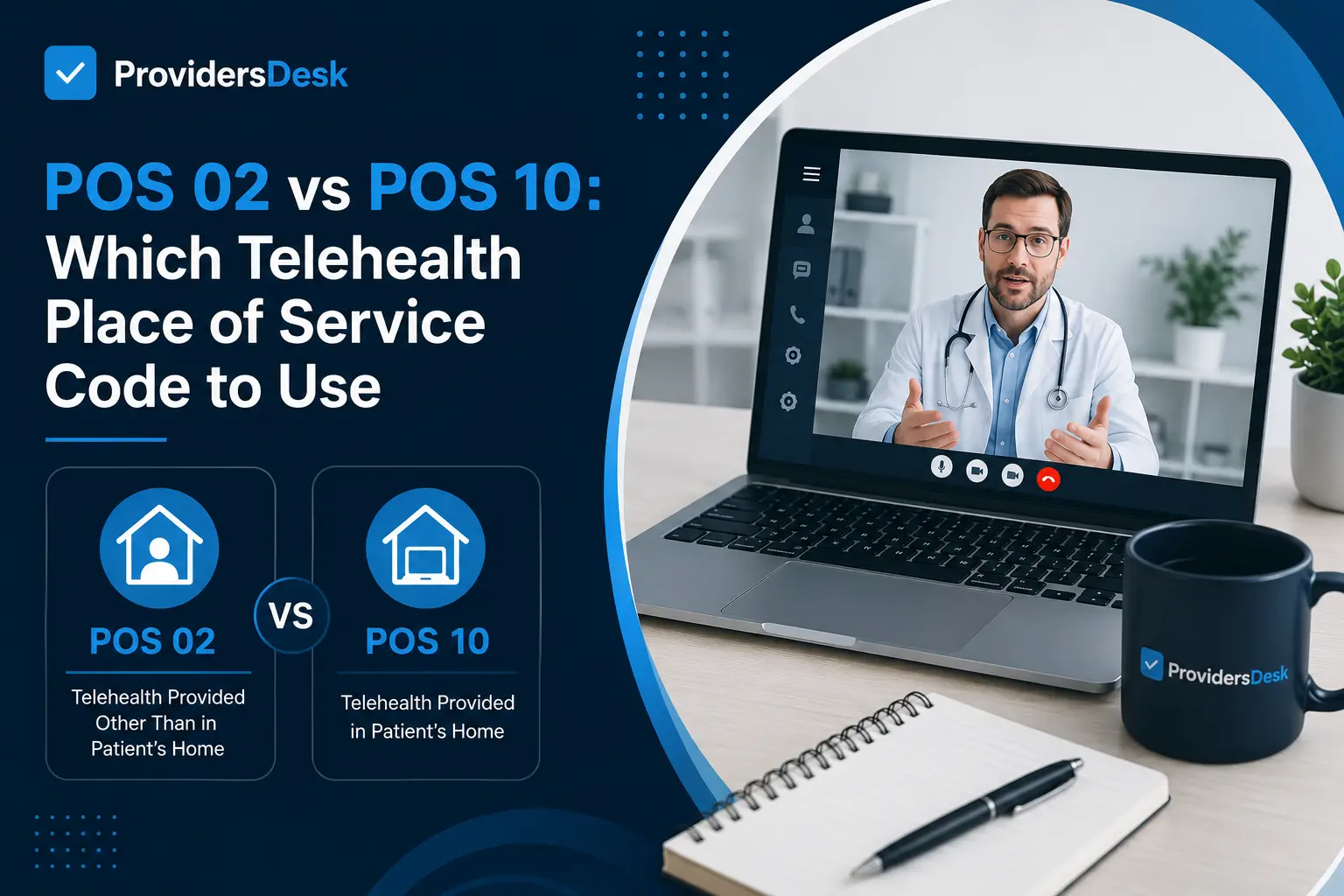
If you want the short version: POS 10 when the patient is at home, POS 02 when the patient is anywhere else. The code describes where the patient was sitting, not where you were.
That is the rule. Most of the confusion in telehealth billing comes from what sits on top of it, which is that Medicare and commercial payers do not want the same thing on the claim.
The rule that actually decides it
The place of service code answers one question: where was the patient during the encounter?
Not where the provider was. Not where the practice is. The patient.
CMS defines POS 10 as telehealth provided in the patient's home, which it treats as a permanent or temporary private residence. POS 02 covers telehealth provided anywhere other than the patient's home.
So:
- Patient on their sofa → POS 10
- Patient at work → POS 02
- Patient in a skilled nursing facility → POS 02
- Patient in their car in a supermarket car park → POS 02
- Patient at a satellite clinic connecting to a specialist elsewhere → POS 02
The provider's location does not appear in this decision anywhere.
POS 10 is the newer of the two. CMS added it effective 1 January 2022, with billing effective from April that year, specifically because the patient-at-home scenario had become the overwhelming majority of telehealth and needed its own code.
Why the difference costs money
Here is the part that surprises people.
Medicare pays POS 10 at the non-facility rate and POS 02 at the facility rate. The non-facility rate is typically the higher of the two.
The logic is that when a patient is at home, the practice is carrying the full overhead of delivering that service. When the patient is sitting in another facility, that facility is carrying part of it, so the professional payment is lower.
Which means the code that describes the most common scenario, patient at home, is also the one that pays better. That is not a loophole. It is the payment structure working as designed.
And here is where it goes wrong.
Once a biller learns that POS 10 pays more than POS 02, there is an obvious temptation to make POS 10 the default.
Do not do this.
The place of service is a factual statement about the encounter, and it has to be supported by what is in the note. If a patient was in a skilled nursing facility and the claim says POS 10, that is not an optimization. It is an inaccurate claim, on a code that is trivially easy to audit because the payer can see the patient was in a facility on that date.
If your telehealth POS distribution is 100% POS 10, that is worth looking at. It might be true. It also might mean nobody is asking where the patient actually was.
The practical fix is a single field in your intake or scheduling workflow: where will the patient be? Asked at booking, it takes three seconds, and it makes the POS decision automatic rather than a guess at billing time.
The modifier question, which is where most denials come from
This is the part that trips up practices that bill both Medicare and commercial.
Medicare fee-for-service identifies telehealth through the place of service code itself. POS 02 or POS 10 is the signal. Modifier 95 is generally not required, and Medicare has moved away from modifier GT for most situations.
Most commercial payers and Medicare Advantage plans want modifier 95 on the claim, and a number of them still expect POS 11 with that modifier rather than POS 02 or 10 at all.
So the same encounter, billed to two different payers, may need genuinely different claims:
| Place of service | Modifier | |
| Medicare FFS | POS 02 or 10 | usually none |
| Many commercial plans | POS 11 | 95 |
| Some commercial plans | POS 02 or 10 | 95 |
There is no way to shortcut this. Payer telehealth policy is one of the areas where the published rules genuinely differ, and a rule that is correct for one plan produces a denial on another.
If you take one operational action from this article, make it this: build a small internal table of your top ten payers and what each one wants on a telehealth claim. Check it once a quarter. It will pay for the time it takes within a month.
Audio-only is a separate question.
Everything above assumes real-time audio and video.
If the encounter was audio-only, the modifier changes. Modifier 93 indicates a synchronous audio-only service, and modifier FQ exists for federally qualified health centers and rural health clinics providing audio-only telehealth.
Coverage for audio-only has been tightening as video access has become more universal, and several large commercial payers have restricted or removed reimbursement for telephone-only visit codes. Verify before you bill rather than after the denial.
Common mistakes worth checking for
Using the provider's location. The single most frequent error. The POS is about the patient.
Defaulting to POS 11 for everything. POS 11 means an in-person office visit unless the payer specifically directs otherwise for telehealth. Using it by habit on a telehealth claim will produce either a denial or an incorrect payment.
Assuming last year's rules still apply. Telehealth policy has changed repeatedly since 2020 and continues to change. A workflow built on 2023 guidance may be quietly wrong.
Not documenting the patient's location. If the POS says the patient was at home, the note should support it. That single line is what protects the claim in a review.
What to do next
- Add "where will the patient be?" to your telehealth booking flow
- Build the payer table described above for your top ten payers
- Check your current telehealth POS distribution. If it is entirely one code, find out why
- Confirm your clearinghouse is not silently rewriting the POS on outbound claims, which some do
You can look up any place of service code, including the full CMS descriptor, in the place of service tool.
Sources
- CMS Place of Service Code Set — the definitional authority for POS 02, 10, and 11
- Your payer's own provider manual, which overrides everything else here for that payer
Reference information only. Not billing advice. Verify against the payer before you file.
Related guides
Modifier 25 has always carried audit risk. Now it carries payment risk too. Several payers reduce the E/M reim...