Modifier 25 in 2026: The Rules Changed, and Not in Your Favor
Modifier 25 has always carried audit risk. Now it carries payment risk too. Several payers reduce the E/M reimbursement on modifier 25 claims automatically, regardless of how well documented they are, which is a different problem from a denial and needs a different response. Plus the same-diagnosis myth that costs practices money in both directions.
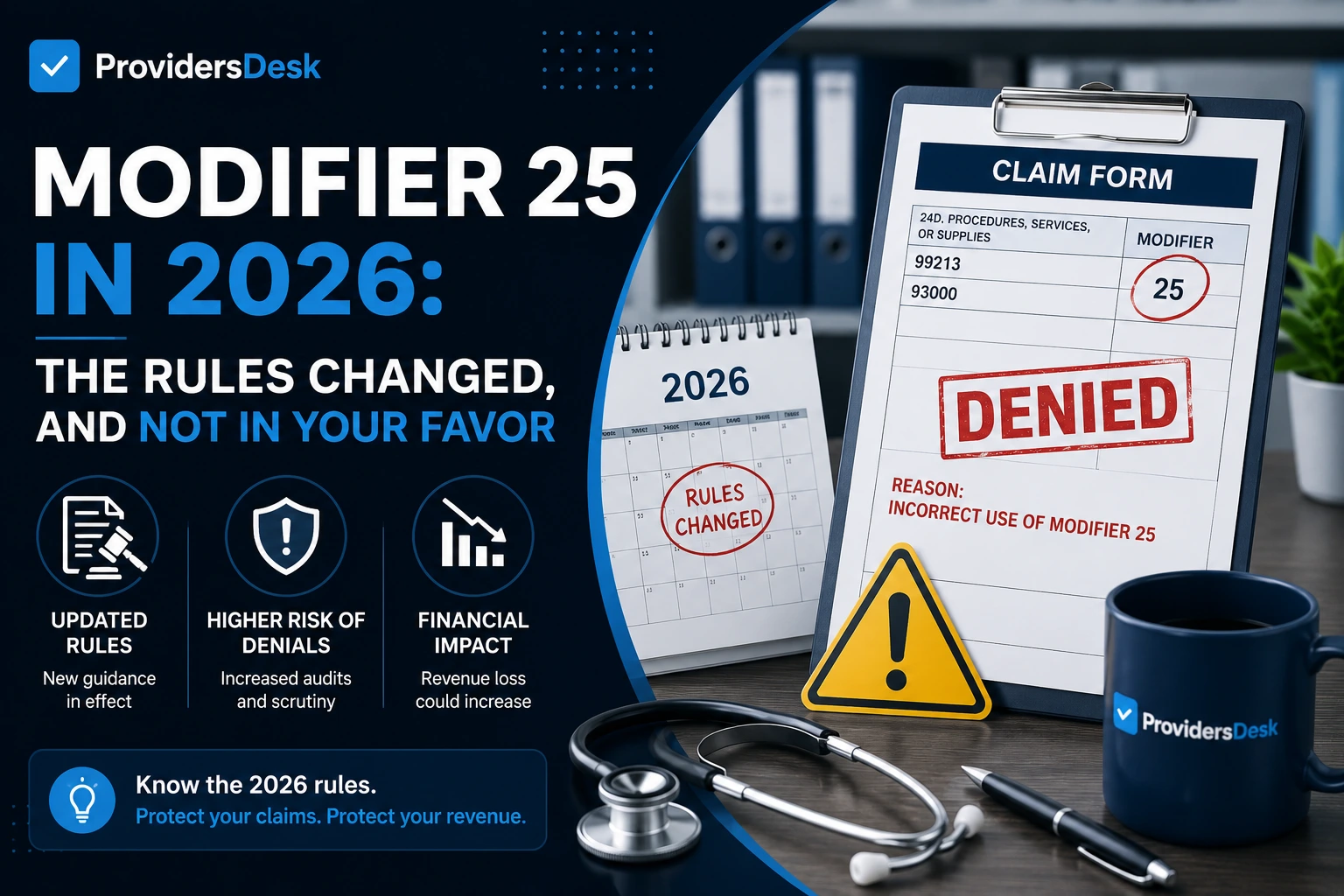
Modifier 25 indicates to a payer that the office visit you performed was separate from the minor procedure you performed on the same day. That has not changed. What has changed is that billing it correctly no longer guarantees you will be paid in full.
Several payers now automatically reduce the E/M payment on modifier 25 claims, regardless of documentation. That is a different problem from a denial, and it needs a different response.
The shift worth knowing about
Modifier 25 has always been the most audited modifier in billing. The traditional risk was a denial or a post-payment recoupment if documentation did not hold up.
Now there is a second risk. Beginning May 1, 2026, Blue Cross Blue Shield of Michigan and Blue Care Network reimburse applicable E/M codes billed with modifier 25 on the same date as a minor procedure at 50% of the contracted rate. The procedure itself still pays in full. It applies to their commercial and Medicare Advantage lines.
That reduction is not a denial and not an error. It is a policy decision, applied to claims that are documented perfectly. There is nothing to appeal.
One payer in one state is not a national rule. But it is one example of a direction several payers are moving in, and the practical consequence is the same wherever it lands: you need to know what your own payers actually pay for a modifier 25 E/M, not just whether they allow it.
What the modifier actually claims
When you perform a minor procedure, the payment for that procedure already includes a certain amount of evaluation. Assessing the site, explaining the procedure, deciding to do it. That work is baked in and is not separately payable.
Modifier 25 asserts that you did evaluation work beyond that. Something significant enough, and separate enough, to stand as its own service.
The test is not whether you talked to the patient. It is whether you would have performed that evaluation had the procedure not happened.
The same-diagnosis myth
This one costs practices real money, and it is worth stating plainly.
You do not need a different diagnosis. The CMS NCCI Policy Manual is explicit that an E/M service billed with modifier 25 may carry the same diagnosis as the procedure. What matters is documentation showing distinct evaluation work, not a different ICD-10 code sitting on the E/M line.
Plenty of billers believe the opposite, usually because a payer once denied a claim and the appeal succeeded after a second diagnosis was added. That is correlation, not the rule.
The harm runs both ways. Practices leave money on the table by not billing a legitimate E/M because the diagnosis matched. Others attach a loosely related diagnosis to satisfy an imagined requirement, which is a worse problem than the one they were solving.
If a genuinely distinct diagnosis exists, use it. It makes the claim easier to read and easier to defend. Just do not invent one.
Modifier 25 or modifier 57: the global period decides
These two get confused constantly, and the rule for choosing between them is mechanical.
| Modifier | Global period | What it says |
| 25 | 000 or 010 day (minor) | A separate E/M happened alongside a minor procedure |
| 57 | 090 day (major) | This E/M is where the decision to operate was made |
Look up the global period on the procedure code and the choice makes itself. Using 25 where 57 belongs is one of the more common denials in surgical practices, and it is entirely avoidable.
Modifier 59 is a third source of confusion here. It applies to procedures, never to E/M services. If you find yourself considering 59 on an office visit line, something has gone wrong upstream.
It goes on the E/M line.
Append modifier 25 to the E/M code, not to the procedure. This sounds obvious, and it is a frequent enough error that most payer policies call it out.
A modifier 25 on the procedure line does nothing useful and usually produces a bundling denial on the E/M, which then gets worked as a documentation problem when it was a placement problem.
What documentation has to show
The standard is not high, but it is specific. A reviewer reading the note should be able to see two distinct pieces of work.
- Separate notes, or at minimum clearly separated sections. One paragraph covering both services is the single most common reason a modifier 25 claim fails review
- Evaluation content that is not procedural preparation. History, examination, and decision-making that stands on its own
- A reason the evaluation happened. Something prompted it beyond the fact that a procedure was scheduled
- Medical necessity stated, not implied
The practical version of this: the E/M note should still make sense if you deleted the procedure note entirely. If it does not, the E/M was probably part of the procedure.
When not to use it
- The visit was procedural preparation only. Reviewing the site, obtaining consent, explaining aftercare. That is included in the procedure payment.
- The patient came in specifically for the procedure, and nothing else was assessed.
- The E/M and procedure notes are one block of text with no separation. Even if the work was genuinely separate, you cannot demonstrate it.
- The E/M led to a major surgery decision. That is modifier 57.
- Out of habit. A modifier 25 rate far above your specialty norm is one of the clearest audit triggers there is.
Watch your own rate
The most useful compliance measure here is not reviewing individual claims. It is knowing what proportion of your E/M visits carry modifier 25, by provider.
That number varies legitimately by specialty. Dermatology and orthopedics sit far higher than primary care, and nobody expects otherwise. What matters is the outlier inside your own group: one provider at double everyone else, doing the same work, is worth a conversation before a payer has it for you.
The OIG has published audit findings on same-day E/M billing in specific specialties, and those reports are the clearest available guide to how reviewers actually evaluate these claims. They are worth reading if your practice bills modifier 25 at volume. Start at oig.hhs.gov.
What to do next
- Pull your modifier 25 rate by provider for the last six months and look for the outlier
- Check your three largest payers for a modifier 25 reimbursement policy. Reduced payment is now a real possibility, and it will not show up as a denial
- Review five recent modifier 25 notes. Ask whether the E/M section stands alone with the procedure note removed
- Confirm the modifier is landing on the E/M line, not the procedure line, in your billing software
- Check the global period before choosing between 25 and 57
A note on which modifiers we publish
Modifier 25 is a CPT modifier, owned by the American Medical Association, so it does not appear in our lookup tools. Our modifier lookup covers HCPCS Level II modifiers, which CMS publishes in the public domain. That distinction is why you will find GP, KX, and TC here but not 25, 59, or 57.
A reduced payment is a contractual adjustment, not a denial, and it arrives looking like one. CO-45 explained covers how to tell the difference and why you cannot bill the patient for it.
Sources
- CMS National Correct Coding Initiative — the policy manual is the authority on same-diagnosis billing
- BCBS Michigan modifier 25 policy update — one example of the reimbursement change described above
- Your own payer’s reimbursement policy, which is the only authority for your claims
Reference information only. Not billing advice. Verify against the payer before you file.
Related guides
Medicare wants POS 02 or 10 and no modifier. Most commercial payers want POS 11 with modifier 95. Getting the...